





Today we’d like to introduce you to Meg Davis.
Meg, we appreciate you taking the time to share your story with us today. Where does your story begin?
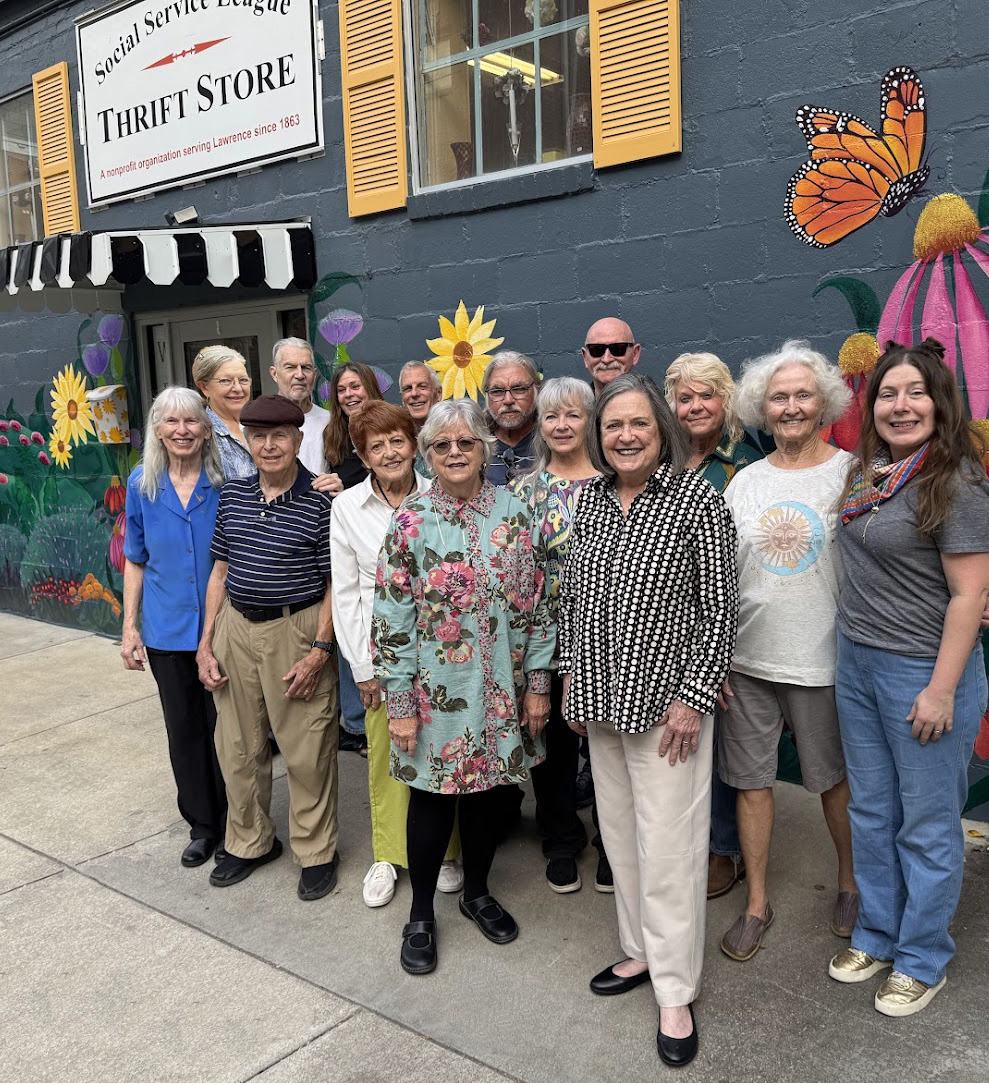
The Social Service League is the oldest non-profit in Douglas County; its history goes back to 1863. We attribute our longevity to our ability to change with the changing needs of the community. In our earliest years we provided the first two public hospital beds; we had a sewing room, a canning kitchen and in 1919 we opened a thrift store. From the mid 1900’s to about 2010 the store sold clothing price very cheap or free on voucher, but inflationary creep caused overhead to exceed revenue, and something had to change.
I joined the board of directors about 15 years ago and I was able to bring on some other excellent board members. Fast forward to 2025 and the buildings have all been repaired, including the addition of a beautiful mural by our local, native artist, Mona Cliff.
We saved money because board members and key volunteers were willing to do all the repair work for free. As old employees retired, board members like me took over running the store as volunteers, and that saved salary expenses. Currently we have only two part-time employees, all other work is done by volunteers. While the physical work was being done, we were also re-inventing the organization. We started by changing the business model of the store. A store with small square footage like ours could not sustain itself at low prices; you literally cannot run enough customers through to cover overhead. And the key to our being in a position to help people in our community was having the funds to expand programs. One of the first things we did was to write into our board rules that no one affiliated with our organization would get free items, discounted items or first dibs on items. We needed donors to know when they gave us something valuable, it would be sold for the best price and the proceeds used to help community members in need. Although we up scaled the store, we still maintain a voucher system, where we give thousands of dollars’ worth of clothing, housewares and necessary items away each month. High end items like gold & silver jewelry, wool, cashmere sweaters, original art, designer wear and collectibles are sold in store for about 50% off what we find them priced online for. Sweaters and Jewelry are by far our biggest revenue makers. We have a small presence on eBay, but we much prefer keeping things local. With our new business model, we are only open for sales one day per week (Saturdays 10:00-4:00), and in that 7-hour window we make as much in sales as we used to make back when we were open 40 hours per week and had 4 employees. Weekdays we are at the store or in our offices, working on programs, with community service workers or voucher clients and/or processing donations. We have a very unusual store. We use the back door as our entrance and it’s in an alleyway, so we are hidden. Add the fact our store is filled with beautiful things, its easy
to see why people call us “the hidden gem”. We have the best 60s rock music playing, and we have a store mascot that is a giant Australian stick bug that people come to see (and sometimes hold). Our customers love her. Our store can literally get packed with people on Saturdays. We have the most wonderful customers. Rare is the place where you can see young people and old people all shopping happily nudging elbows. People sometimes sing and we often have a lot of laughter going on. Sometimes I will just stop and listen and marvel at how happy the store sounds. Last Saturday two ladies walked in for the first time, and hearing the sound one exclaimed, “Is this a store, or is there a party going on here?!” One of our Board members calls Saturdays “game day” because we work so hard during the week on programs and trying to process donations to keep the store beautiful – Saturdays make it all worthwhile. We meet wonderful, interesting and generous people in our donor and customer base. When our customers try on clothes, they put the ones they don’t want back on the racks (to save us the work). There's no store like it. The proceeds for all the Saturday sales go to very worthy causes. We fund the Drug Court Alum program; a group of drug-fee, productive men and women who create substance free venues for people getting clean, where they can be mentored and find new friends. The Douglas County Drug Court program is an outstanding program, and we are very proud to support it.
We have a Vision program that supplies free eyeglasses and exams to people who have no other resources. We supply work clothes and brand-new steel- toed boots to people getting back into the work force. We have a Random Acts of Kindness program (RAK) that can help with emergency funding up to $500. This year we started a new program Teacher’s Assistance Grant (TAG) which gives grammar schoolteachers $250 in classroom funds. We are about to announce a program that is nearest and dearest to my heart. It’s called the Empower-U program. The objective is to help our high school teens who are suffering terribly from anxiety and depression. According to National Institute of Health studies 4 out of 10 high school students are on anti-anxiety or anti-depression meds. Add in the fact that 27% are truant, and those who do not graduate or get a GED are 3.5 times more likely to become homeless in the future, the picture is quite unsettling. Lastly, in college freshmen who were interviewed
for one study, 20% said at one time or another, they had considered suicide. These young people need help. Teachers, counselors and mental health professionals are doing the best they can under very trying circumstances with limited resources. The good news is, the National Institute of Health Library and the Journal of American Medical Association both have studies that show exercise can have a profoundly positive effect of teen anxiety and depression. Martial Arts is one of the forms of exercise mentioned in the studies. We’ve teamed up with Premier Martial Arts here in Lawrence. Premier specializes in teaching self-protection to children and teens. We are going to fund a pilot study with 20 teens, all expenses paid for classes twice a week for six months, to see if we can jump-start some of them back into a more positive frame of mind. We are committed to trying to emulate the NIH & JAMA studies that showed what a profound effect exercise can have by getting teens out of their isolation, away from electronics and into a potential new friend base while boosting body function. Our entire board and volunteer base are very excited about the potential for helping the teen population, and with any sign of success we are committed to expanding it into other forms of exercise (and if we have the funding) by incorporating many more participants.
Can you talk to us a bit about the challenges and lessons you’ve learned along the way. Looking back would you say it’s been easy or smooth in retrospect?
There is a wonderful old saying, “Great sailors are not made on smooth seas.” Neither are great organizations. Fortunately, we have a small, but outstanding Board of Directors who seamlessly bring together business logic and dedication to our goal of working toward the greatest good. Our President, Linda Maxey has been an outstanding leader, and I would be remiss if I did not give thanks to Patty McGuire, our Treasurer and Cathy Barker, our Secretary – they are the core of our workforce and leadership. Other board members (their spouses) and key volunteers have contributed enormously to our success. We could not have gotten this far without every one of them. It has not always been a smooth road. People tend to resist change, at least at first and especially if they don’t quite understand the reasoning behind the change. When we started getting high quality items in, they naturally were priced higher than the usual fare. Most thrift stores have clothes from Kohls, Penny’s Walmart or Target; we occasionally carry those items too and the norm is about $7.99- $9.99. But we also have art, jewelry, collectibles and mink or wool coats priced from $25-$1,500. First time customers can be quite surprised because the kind of quality we have is rarely seen at the regular thrift stores. Many people think the word “Thrift” means”cheap”, but it really means “using money resourcefully and not wasting it.: Buying a $200 sweater for $65 to $95 is quite thrifty.
Fortunately, as we were able to improve the store and expand our programs, the old-time customers (who were the ones most resistant) were inclined to admit, it was nice to have beautiful items to buy, even if you only bought two or three at the going prices. And they realized the good we were doing with store revenue was worth the change. Plus, our customer base grew from word of mouth, and we have new customers come in every week who only know us as we currently are. People come in from surrounding cities to shop here now. Through the years the workload was a struggle. Many board members and volunteers put in untold hours. Resale stores are notoriously difficult because you can work so hard to extract order from chaos and in the blink of an eye you can have chaos again with incoming items that need to be sorted, cleaned, priced and put out for sale. It can be exhausting. Also, through all these years we have been a primary help-spot for the homeless. They come to us for coats, clothes, boots, blankets etc. So often you see the same men and women year after year, and it can be quite discouraging for our volunteers. You start to wonder if you are helping or enabling. It’s such a fine line. Volunteer workers (which we all are), need to feel they are truly making a difference in people’s lives. Douglas County Drug Court was an association that came along just when we all needed some fresh inspiration. Their clients do community service with us and we love the program because you can see the difference in the lives of people who are working to help themselves and who appreciate the help we provide toward that end. Emotionally you have your ups and downs, but we have kept going and growing
Alright, so let’s switch gears a bit and talk business. What should we know about your work?
There are so many things that set us apart from other non-profit organizations. We are very old, yet we stayed local and personal. We don’t take any city, state or federal grants, and that gives us more flexibility. We self-subsidize through store sales, and we are bolstered by cash donations from donors who believe in how we do things and what we accomplish. Just today I had a donor say “I’ve donated to a lot of different non-profits, and I’ve never met one as consistently friendly, warm and appreciative of the items I bring. Many of these are things I’ve loved for so long, and it’s hard to part with them. I’m happy I found you.” Our donors have been through so much, particularly with Covid and the loss of loved ones – mostly parents, but spouses too. It has been extremely hard on them. The experience of parting with their donations can be quite emotional for them and for us.
I remember a woman who brought in her father’s leather tam o’ shanter. It was vintage, but still a beautiful, well-kept hat. If you saw it on the shelf of a place like Goodwill, you’d think of it as just a cool old hat. But to us it had a story. She told us she saw him in it the whole time she was growing up. She held it so long in her hand; she had tears in her eyes, and I could tell she was wondering if it was a betrayal to part with it. I assured her we would find someone who would love that hat, and maybe some other little girl will see her father in it. I warned her that she better get control of herself because I am a “group crier” and we’d have a real mess on our hands otherwise. She wiped away her tears and smiled; she was visibly relieved when she finally handed us the hat. And just as that was not “just some cool old hat” the beautiful China plate that you sat down to for Thanksgiving, Christmas or Hanukkah dinner sharing family memories year after year, is not just a plate, and your mother’s favorite sweater will always be more than a sweater. Most donors feel this way, and we keep that foremost in our minds. We are almost like “middlemen” who are given something precious and then have the job of transferring that object to someone else who will feel it’s preciousness and continue to care for it. At the same time, that transaction generates the revenue which we can use in our programs to help people stabilize their lives and move forward.
How do you think about luck?
We don’t believe our success was ever dictated by luck. We think more in terms of karma: a mathematical system that can produce seemingly improbable outcomes, that
would, no doubt, be perfectly logical if we could trace the effects of all the positive
influences and hard work we put into play.
Pricing:
- $2.99
- to
- $1,500
Contact Info: