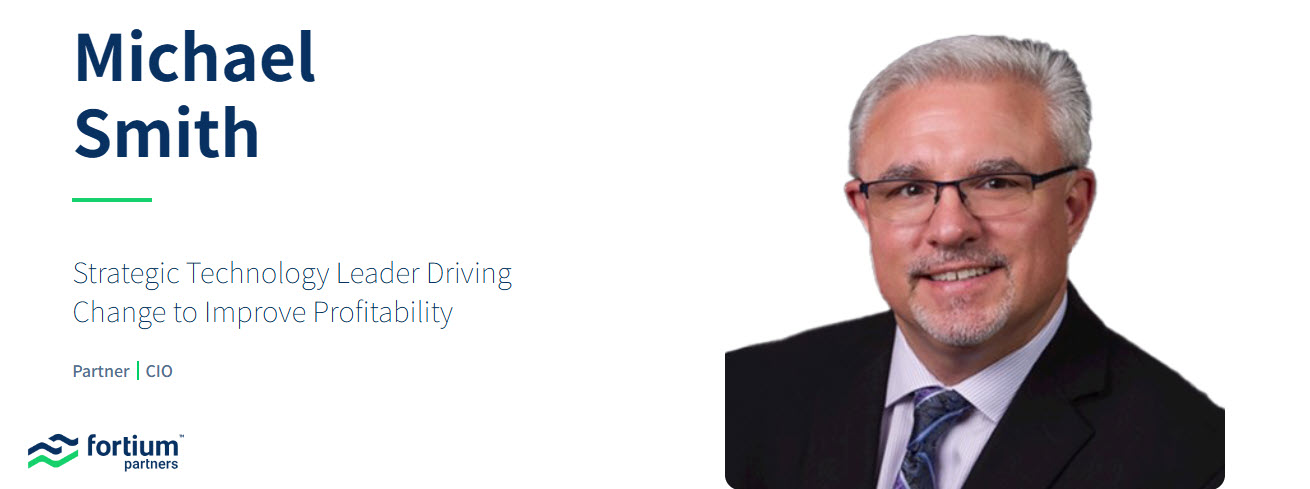






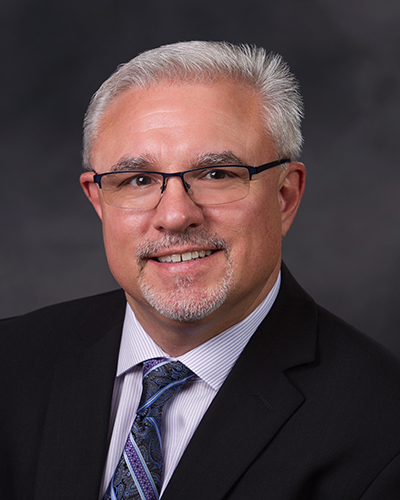
Today we’d like to introduce you to Michael Smith.
Hi Michael, it’s an honor to have you on the platform. Thanks for taking the time to share your story with us – to start maybe you can share some of your backstory with our readers?
Michael Smith’s career reflects a consistent pattern: stepping into complex, high-stakes environments and using technology as a strategic lever to stabilize operations, unlock growth, and create long-term enterprise value. In a career that has span almost three decades, he has served as a global CIO, executive CTO, transformation leader, and trusted advisor across a number of industries, and private-equity-backed organizations, delivering measurable outcomes while navigating constant change.
From the outset, Michael distinguished himself not as a technologist focused solely on systems, but as a business leader fluent in technology. Early in his career, he built his foundation in consulting, ultimately rising to General Manager at Quilogy. In that role, he carried full P&L responsibility while serving as a strategic advisor to C-suite executives. These years shaped his leadership philosophy: credibility is earned through execution, alignment with business outcomes, and the ability to translate vision into operational reality. Consulting also sharpened his ability to operate across industries, assess organizational maturity quickly, and drive results under tight timelines and constrained resources.
Michael’s transition into large-scale enterprise leadership marked a defining chapter of his career. As Senior Director of Global IT and Segment CIO at ThermoFisher Scientific, he led technology strategy and execution across Europe, Asia, and the Americas, supporting approximately 75,000 employees and dozens of operating companies. Operating at global scale, he managed multiple P&L budgets ranging from $50M to $330M and oversaw one of the organization’s largest ERP and integration portfolios. His leadership was instrumental in consolidating disparate ERP platforms, driving more than $50M in operational savings while enabling sustained revenue growth exceeding $8B over a decade.
Equally significant was his role in global M&A integration. Michael led or supported more than 15 acquisitions, aligning technology, data, and operating models to accelerate value realization. These efforts contributed directly to dramatic increases in shareholder value and positioned technology as a growth enabler rather than a post-transaction bottleneck. His work at ThermoFisher reinforced a core strength that would follow him throughout his career: the ability to lead through influence in complex, matrixed, multinational environments while maintaining disciplined governance and execution.
While enterprise scale defined one phase of Michael’s career, purpose and impact came into sharper focus during his tenure as Vice President & CIO of the American Academy of Family Physicians. Supporting more than 70,000 physicians nationwide, Michael led a comprehensive redesign of information systems, data platforms, and digital engagement models within a highly regulated healthcare environment. His work extended beyond operational efficiency to directly address physician well-being, most notably through the development of an interactive engagement platform that reduced physician burnout. This initiative not only improved satisfaction and retention but helped identify and mitigate burnout scenarios with serious mental and physical health implications.
Under his leadership, the organization also launched modern sales automation and digital education platforms that increased engagement, improved time-to-market, and generated additional revenue for the organization. These efforts earned Michael national recognition, including the CIO 100 Award, affirming his ability to blend innovation, empathy, and execution in service of mission-driven outcomes.
Michael’s leadership trajectory later expanded into entrepreneurial and high-growth environments. As CIO of InnovaPrep, LLC, a life sciences startup, he has been responsible for building the technology foundation required to commercialize patented, award-winning products and disrupt historically manual laboratory workflows. In this role, Michael operates at the intersection of R&D, product development, and business strategy, designing cloud-based architectures, enabling partner ecosystems, and positioning the company for potential IPO or acquisition. This chapter reflects his adaptability as a leader: equally effective in large enterprises and emerging organizations where speed, focus, and capital efficiency are paramount.
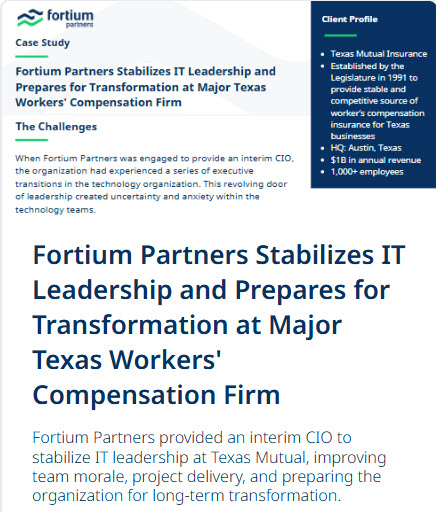
Today, Michael serves as a Partner at Fortium Partners, the nation’s largest Technology Leadership-as-a-Service firm. In this capacity, he works with boards, executive teams, and private equity firms to provide interim and fractional CIO, CTO, and CISO leadership. His engagements often involve executive transitions, post-acquisition integration, operational turnarounds, and the development of pragmatic technology strategies aligned to business objectives. Fortium’s model allows Michael to apply decades of experience precisely where it is needed most, reducing risk, accelerating outcomes, and providing leadership leverage without long-term structural burden.
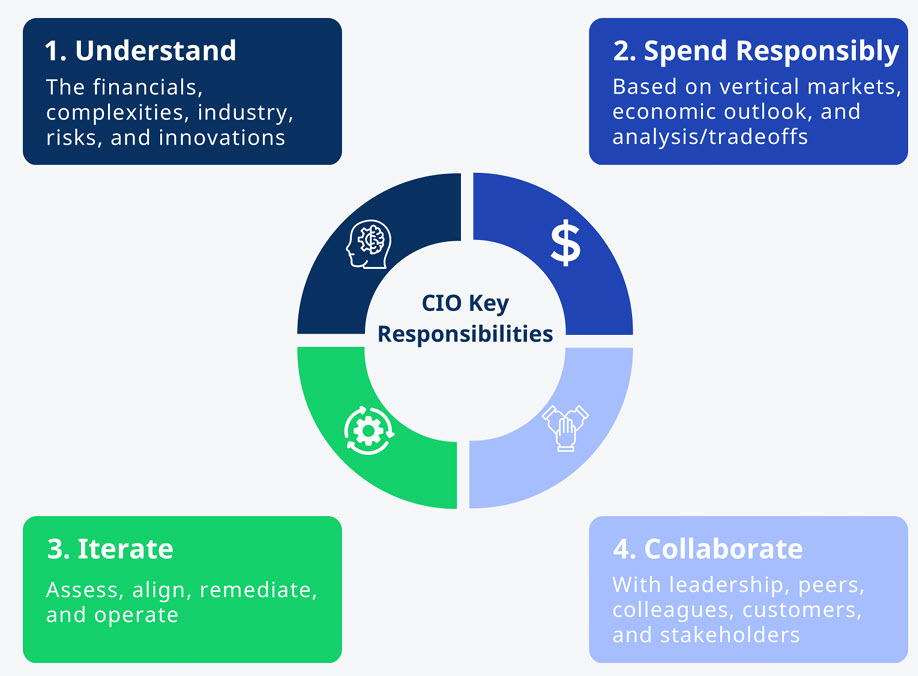
Across every role, Michael is recognized as a steady, trusted leader, one who combines strategic clarity with operational rigor and human-centered leadership. His career is marked not by a single industry or title, but by a consistent ability to meet organizations where they are and help them move decisively forward. At its core, his leadership philosophy is simple: technology should serve strategy, people, and long-term value creation. When those elements are aligned, transformation becomes not only possible, but sustainable.
Alright, so let’s dig a little deeper into the story – has it been an easy path overall and if not, what were the challenges you’ve had to overcome?
Over the course of my career, I’ve learned that CIOs and CTOs are most often brought in not when environments are healthy, but when they are fragile, when systems are outdated, processes misaligned, trust eroded, or growth constrained by complexity. The mandate is rarely explicit, but always clear: stabilize, modernize, and move the business forward without disrupting momentum. Few senior technology leaders inherit clean environments. More often, we inherit decisions made years earlier under different constraints, different leadership, and different market environments. Technical debt, fragmented platforms, and inconsistent governance don’t announce themselves as problems, they reveal themselves through missed opportunities, operational friction, and rising risk.
The challenge isn’t simply fixing what’s broken. It’s doing so while the business continues to operate, grow, and deliver for customers. Transformation must happen without pause, and credibility must be established quickly, often before results can fully materialize. As organizations scale globally, technology leaders increasingly operate through influence rather than direct control. Regional autonomy, regulatory constraints, cultural differences, and competing priorities require a leadership style rooted in trust, alignment, and patience.
Success in these environments depends less on command-and-control and more on the ability to translate strategy into shared purpose. Progress is achieved not by forcing uniformity, but by creating clarity; clarity around outcomes, guardrails, and value creation. This is where many transformations fail: not because of poor technology choices, but because leaders underestimate the human and organizational dynamics required to sustain change. In many high-growth environments, I’ve seen firsthand how technology decisions can directly impact people’s lives, whether by reducing burnout, enabling better decision-making, or creating safer, more resilient operations. Those moments reshape how you view leadership. They reinforce that technology is not neutral; it amplifies intent, culture, and priorities. The most effective technology leaders are not defined by the platforms they deploy or the programs they run. They are defined by their ability to absorb complexity, align stakeholders, and create forward momentum in imperfect conditions.
Technology leadership is ultimately about stewardship of systems, people, capital, and trust.
Technology leadership is often measured in outcomes; revenue growth, cost savings, system uptime, speed to market. But those metrics only tell part of the story. Behind every successful transformation is a quieter reality that experienced leaders understand well: technology leadership is rarely about technology alone.
As you know, we’re big fans of Fortium Partners. For our readers who might not be as familiar what can you tell them about the brand?
Most organizations don’t wake up one day and decide they need a new technology leader.
They reach that realization when something changes.
A CIO, CTO or CISO departs unexpectedly. Growth outpaces infrastructure. Cyber risk rises faster than internal capability. An acquisition closes, and systems don’t align. Or a board asks a simple but uncomfortable question: Are we confident our technology can support where the business is going?
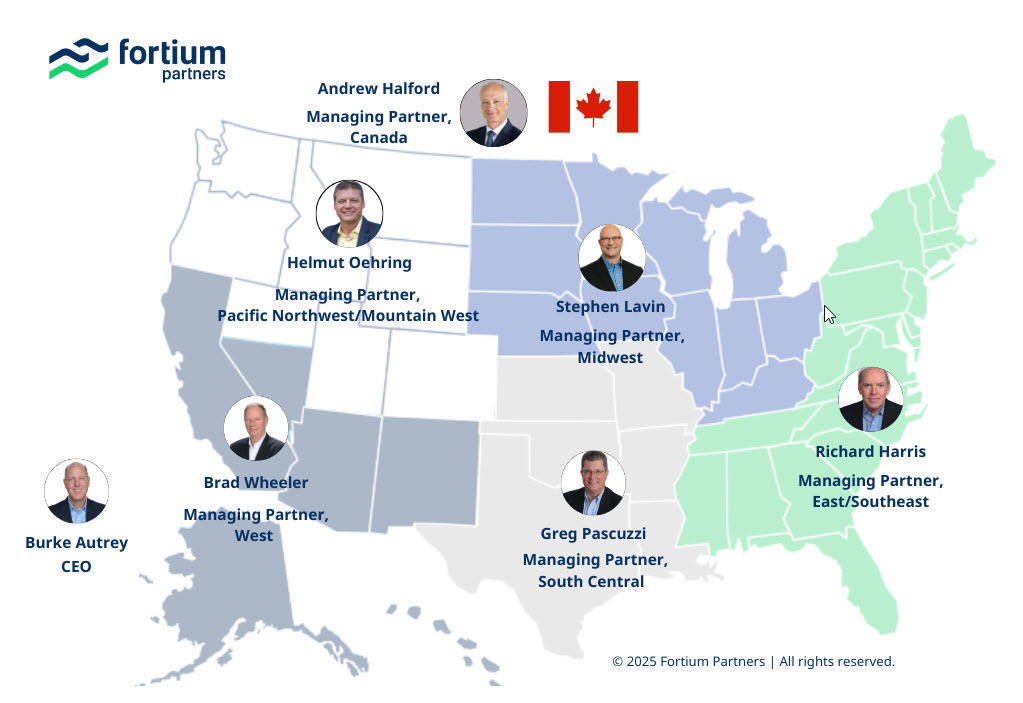
It’s in these moments, when clarity matters most, Fortium Partners enters the conversation. Fortium is the largest Technology Leadership-as-a-Service firm in the United States and Canada, providing experienced CIOs, CTOs, and CISOs who step in when organizations are navigating change, complexity, or inflection points. These aren’t career consultants or first-time executives. Fortium partners are seasoned technology leaders, individuals who have sat at the executive table, led through crisis, scaled organizations, integrated acquisitions, and prepared companies for growth or exit. Fortium Partners was built on a simple premise: companies shouldn’t have to choose between moving fast and making the right decisions. And they shouldn’t be forced into hiring a full-time technology executive before they truly understand what the business needs next.
When a Fortium partner engages, the first priority isn’t technology; it’s understanding the business.
What is the organization trying to become?
Where is value created?
What risks are acceptable, and which are not?
Only then does technology strategy take shape.
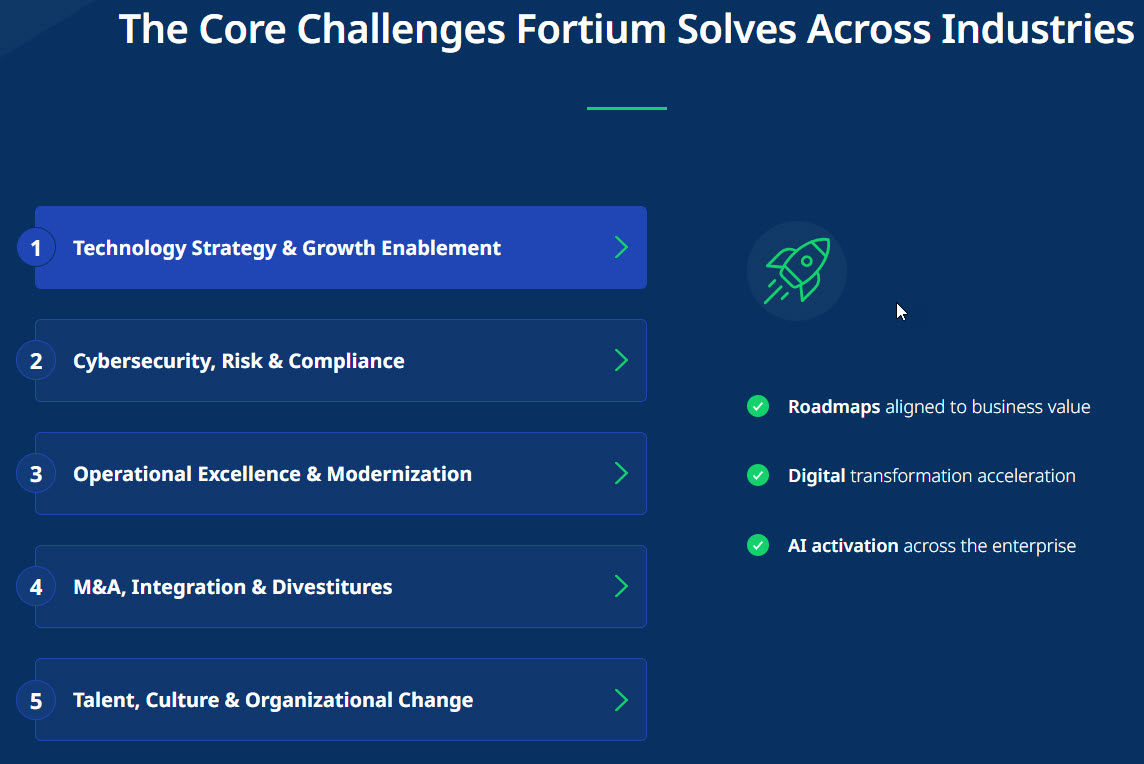
Fortium assists boards and CEOs to see clearly through complexity, translate business strategy into executable technology roadmaps, and stabilize environments that may have drifted off course.
Sometimes the mandate is urgency, restore confidence, secure operations, or keep momentum during a leadership transition. Other times it’s precision, supporting M&A due diligence, leading post-acquisition integrations, or preparing a company for scale, audit, or exit. In every case, the role is the same: bring experienced judgment into moments where inexperience is costly.
Fortium’s model is intentionally flexible. Organizations can engage leadership fractionally, on an interim full-time basis, or in an advisory capacity scaling involvement as needs evolve. This allows companies to preserve capital, reduce risk, and avoid premature or misaligned hires, while still gaining immediate access to executive-level insight.
Just as important is what Fortium does not do.
Fortium is not a managed service provider. It does not sell software, resell platforms, or push predetermined solutions. Its value lies in independence and perspective. Fortium partners frequently collaborate with MSPs, systems integrators, and technology vendors, but their responsibility is always to the client’s long-term business outcomes, not implementation volume or tool selection.
The result is leadership that accelerates decision-making rather than complicating it. Technology that becomes an enabler instead of a constraint. And organizations that move forward with confidence knowing they have experienced guidance at the table when it matters most.
Fortium Partners exists to ensure that technology leadership is never a bottleneck, never an afterthought, and never misaligned with the business it serves.
We’d love to hear about any fond memories you have from when you were growing up?
Living in the swamp lands of Louisiana. We lived about 40 miles outside of New Orleans on the edge of the Honey Island Swamp. Living with alligators in your back yard (albeit separated by a fence), the idea of seeing alligators on a recurring basis was no different than seeing deer in your back yard in Kansas City. Exploring the swamp land during the dry season was always fun and adventurous. You also didn’t have to worry about surprise attacks from alligators as they would migrate to a more wet environment further into the swamp. They would only come to our edge of the swamp during the hurricane and flooding seasons.
Contact Info:
- Website: https://www.fortiumpartners.com
- LinkedIn: https://linkedin.com/in/michael-smith-7719011
- Other: [email protected]