






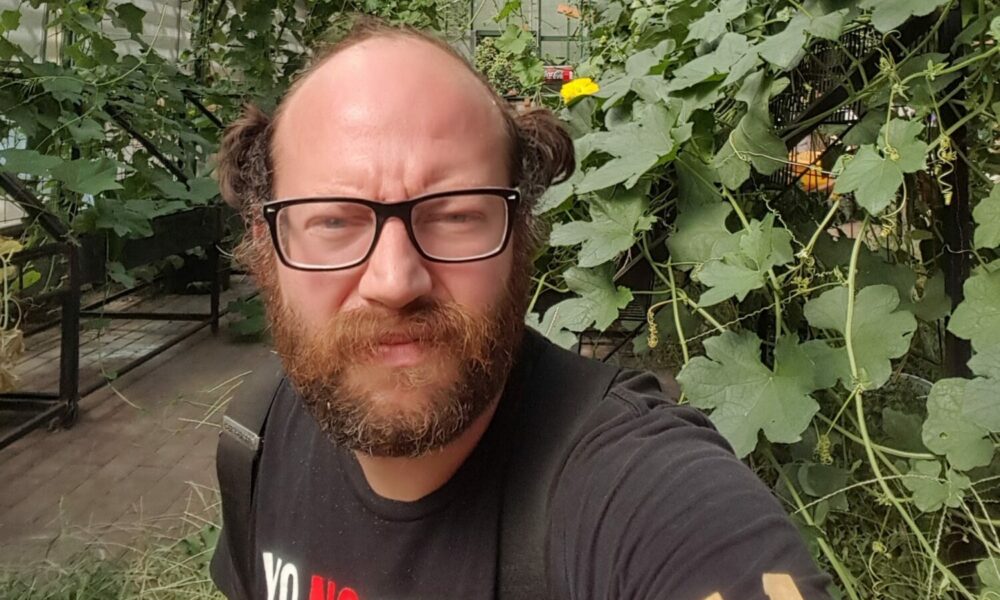
Today we’d like to introduce you to Nicolas Garcia.
Nicolas, we appreciate you taking the time to share your story with us today. Where does your story begin?
When I turned four my family moved into a new home, I am a child of spring and so I can remember vividly helping my mother, aptly called Bea, in the garden planting impatiens, and weeding. and taking in everything she said that year and many years after; as I grew up my father suffered from chronic progressive Multiple Sclerosis and as I learned to read, I became interested in alternative medicine and herbs as medicine.
My mother would be amused and tell me stories about my great grandmother in La Paz, Mexico how she would forage plants and make salves to treat ailments. I never met her, but I always feel connected to her and those that came, before; and so I cannot say where it all began, but that I am a link in a chain that stretches beyond what is remembered and what can be known. At 18 I moved to Lawrence in order to be closer to my older siblings who had established themselves there.
I planted and tended a garden everywhere I moved to after moving out and even if I lacked land access, I would inevitably have either a houseplant or container garden; I would also almost every year be involved with either a community garden or a guerrilla garden off highways, easements, and in parks, once outside the Lawrence Police Department. In 2008, I started Anti-Hero Farms LLC. dedicated to guerrilla growing and edible landscaping. I headquartered in my brother’s yard and basement in Prairie Village.
I remember when I started ripping up his front lawn to plant asparagus and herbs the next-door neighbor came out to ask not “what” I was doing, but if I was allowed to do it. I married my wife Sarah in September and November 2009 and she, having studied horticulture at JCCC, was quick to jump into a life of urban agriculture herself having torn up her lawn in KCK and tended a yard farm. Together we helped establish the Prairie Village Community Gardens, a Children’s Community Garden in Rosedale, some Lawrence Guerrilla Gardens, several KCMO restaurant gardens, and home food gardens.
Anti-Hero operated until we found our current nursery and urban farm location at 8105 Main St. in KCMO, shuttering Anti-Hero in 2013 in order to dedicate our energies to what has become Treehouse Urban Farm. Over the last decade, we have balanced child rearing, and day jobs, and invested every spare cent and moment in building this natives nursery and urban farm.
Currently, I am a Fellow with the National Young Farmer’s Coalition Land Access Fellowship; we are organizing listening sessions and fostering conversation and cooperation intent on influencing the 2023 Farm Bill to shift power and policy to equitably resource our new generation of working farmers, allocate $2.5 billion and 1 million acres to young and BIPOC farmers as over the next decade, foster environmental wellbeing in farming practices, make farming communities safe from racial violence, and foster an agricultural industry concerned with health over profit.
I’m sure you wouldn’t say it’s been obstacle free, but so far would you say the journey has been a fairly smooth road?
The road has not been smooth or easy. For starters, the land was a compacted gravel lot with heavy clay deposits and little organic matter; the 2,500 square foot greenhouse was filled with the jetsam of a hoarder, and the 5,000 square foot shade house was choked by invasive vines stretching past the slats in the roof and binding a decade’s worth of rotting logs to the floor dropped there by the former owner’s arborist son.
My Father would say to me when confronting the trials of life, “Use what you got and make do…” and so we researched how to make our obstacles into advantages. That is when we dug up an old Austro-Hungarian permaculture soil building technique called Hügelkultur. Basically, we dug several trenches and built hollow mounds wherein we buried the rotting logs amidst layers of leaf litter and compost capping the mounds in thick layers of composted manure. This process takes about 2 years as the mounds will settle each season and need to be filled in the following spring.
Over the establishing seasons, we planted annual vegetables and fruits and in the 3rd season, we plant perennials. The process of building soil is one that requires patience, but the outcome is quite rewarding as it reduces the need for fertilization and irrigation due to the science behind the method. Rather than burning carbon to rid ourselves of the abundance of carbon-rich materials, we applied a liberal amount of elbow grease and turned a potential obstacle into an asset. I might add we did all this prep work while also working day jobs and raising our children. In order to work the field while our oldest was younger, we dedicated a fifth of the lot to use as a playground.
We had no budget really, but that fella who owned the property before would sell used tires out of the greenhouse and he left dozens of tires when he moved out so we just used the tires to make the playground. Every year we added a new element from salvaged building materials and when our second child was born we added a multipitted sandbox with different tactile play. The effort to include space for everyone in the family has been rewarding, and it makes the space more accessible to families at our events.
We are living the anarchist ideal life where work resembles play, and we play constantly at Treehouse. These methods could be applied to establishing neighborhood community gardens and urban farms lacking access to city water in order to grow above the soil that may be contaminated, cities could even save the cost of tree disposals by chip dropping at these community gardens and urban farms.
Alright, so let’s switch gears a bit and talk business. What should we know about your work?
Our urban farm is currently dedicated to growing a variety of berries, herbs, and perennial crops, many of which are native to the midwest as well we grow herbs and vegetables integral to Chicano cooking such as nopales, pericon, epazote, cempasuchil, and an assortment of chiles, our favorite being chilaca. We use these uncommon ingredients in making value-added products such as smudge, herbal tea blends, BBQ sauce, chile sauces, and uncommon jams and jellies from fruits like tuna.
We sell our products at pop-ups throughout the KCMO area and are currently compiling recipes for publication. The nursery side of the business specializes in plants native to Kansas and Missouri. We offer our expertise to homeowners in KCMO as consultants for those wishing to establish gardens and landscapes conducive to hosting native insects, and animals with an eye to habitat restoration throughout the metro.
It is an easy hook for people to support habitat for butterflies and bees, but they also need to be down for aphids, wasps, milkweed bugs, spiders, fungus, and a myriad of creepy crawly insects that homeowners are more liable to poison than welcome, because, without the reticulate pattern of a healthy ecosystem, there is only a future that would make Beckett seem optimistic. Throughout the planting season, our native’s nursery is open Saturdays at 8105 Main Street in Kansas City, MO 10 am-3 pm. Seasonally we will vet potential client’s wishing for design work and execute the designs over winter when our outside work slows in the farm and nursery, with the design we will include an explanation and a plan for implementation of the design.
From there if the client requires us to execute the design we will take the following year to prepare the space and install it in the autumn and late winter when the ground thaws. We make a point to not install on the basis of maximizing sales and productivity, but rather to work with what the plants and ecology require. We are most proud of the fact that we are not afraid to tell a client, “no,” if they ask us to work with invasive plants and we love convincing clients to allow us to kill their lawns and other ecologically detrimental plants.
What sets us apart from other nurseries and urban farms is that we are anti-capitalists. Capitalism is a death march to extinction and our work is entirely dedicated to ecological restoration, many times at the expense of profit because when we leave our bodies, we wish to be sure that we spent our lives mitigating harm to the livability of this plant to future generations of life.
Do you have any advice for those just starting out?
The advice I would give others is dependent on who I am speaking. To a cautious person, I would say “Don’t overthink, because you can never know all the pitfalls that may encumber you, the only thing you can control is your determination,” to a headstrong rough shod individual I would recommend more careful planning and to work on as many area farms in order to better understand the field they plan on entering.
To everyone, I would recommend reading, and not just technical reading, but spiritual, philosophical, historical, and political media as well. Read works by Novella Carpenter, Elliot Coleman, The EZLN, Bakunin, Anais Nin, Emma Goldman, Paul Stamets, Sandor Katz, Masanobu Fukuoka, the histories of the French, Chinese, and Mexican revolutions as well as the dispatches from your regional agricultural extension.
Put study into practice. Spend time where you grow, not only in work mode but also in meditation. Observe the life that shares the space with you and find your place among that reticulate pattern. You will make plans, but be flexible, the unbending branch is broken while the supple endures. Talk to people and pick up techniques you are unaccustomed to. Learn from your efforts. Remember the dead. Fight for the living.
Pricing:
- 1-year-old Native Transplant $12.50
- Native Landscape Design $525
- 5 oz. Hotsauce $10.00
- 8 oz. Fermented Smoked Chile Honey $10.00
- 1 hour of my time $75.00
Contact Info:
- Instagram: @treehouse_urbanfarm


 Image Credits
Sarah Faught-Garcia and Nicolas Garcia