






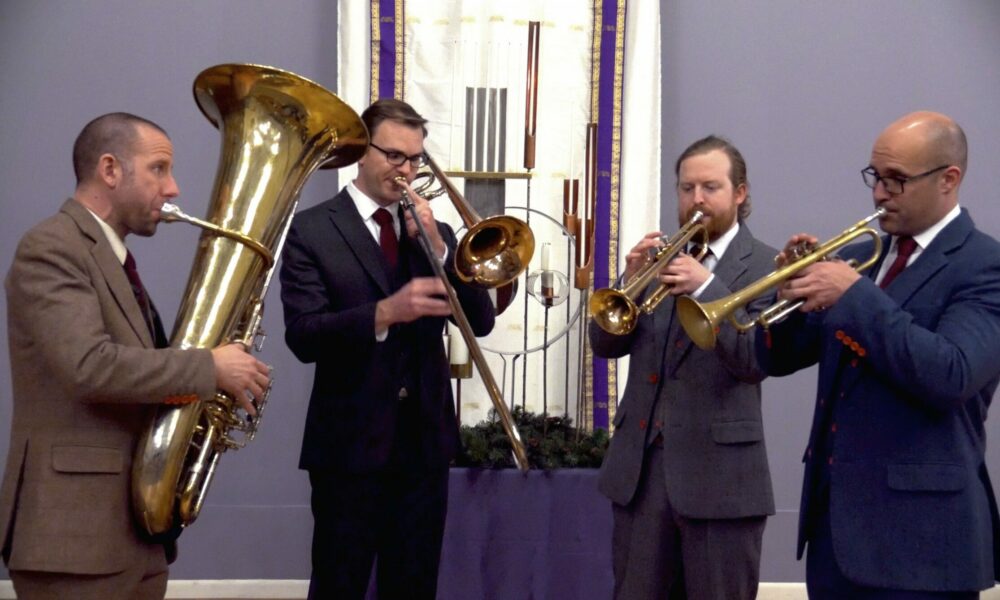
Today we’d like to introduce you to Ångström Brass. Them and their team share their story with us below:
Ångström Brass was founded in August 2014, initially as a brass quintet.
A couple of the players were still in school, so the idea was to get outside the academic sphere. Academia is great but it has its limits. We wanted to work with a mix of student and non-student players, move beyond the semester schedule, refine our performances and repertoire over time, and be accountable to a wider public audience instead of a conservatory jury panel.
It has taken some time to arrive at our current vision for the group, and our current set of musicians. That has also been a process of finding a group of personnel that shares the same vision. We want to play the music that people want to listen to and that we like to play. That might seem obvious, but there are a lot of ways to fall outside of that overlap.
We’ve also tailored the format and repertoire over time to serve a number of different markets. In addition to playing concerts, we do church work, middle school-level through university-level master classes, and other miscellaneous engagements.
We’ve had many awesome players in the group over the years, but our current lineup features Patrick Doyle and Dustin Williams on trumpet, Andy Toews on trombone, and Joseph Felton on tuba. In addition to Ångström Brass, we all freelance, and we all have other jobs as well.
Patrick is a photographer at Austin Custom Brass, a KC-based online brass instrument retailer. Dustin teaches at William Jewel College and runs a gym called Crossfit Gratitude in Kearney, MO. Andy works as an accountant. Joseph repairs instruments, and serves in the Kansas Army National Guard 35th Infantry Division Band.
Ångström Brass has performed live on Kansas Public Radio, been the Ensemble in Residence at Kansas City’s Cathedral of the Immaculate Conception, performed at First Fridays in the Crossroads Arts District, presented concerts for Classical Revolution KC and the Kansas City Musical Club, played university guest artist recitals, presented educational master classes at the middle school through university level, and we’re currently working on our first studio album.
Can you talk to us a bit about the challenges and lessons you’ve learned along the way? Looking back would you say it’s been easy or smooth in retrospect?
It hasn’t been a smooth road or a neat trajectory, but every struggle has brought new opportunities.
When we founded the group, some members were still in college, some were professionals, some were aiming for full-time performance careers, and some were playing music on the side but had corporate day jobs. It was a great-sounding group of great musicians, but our long-term goals weren’t fully aligned.
That misalignment led to personnel turnover. Whenever we’ve had a new member there’s been an adjustment period, because in a quintet each player is twenty percent of the group. We also try to take advantage of the unique skills and personality that each musician brings to the table. The process has led to a great current team, and even with the challenges of the last few years, we have been able to build some good momentum.
The COVID-19 lockdown period was a huge struggle and came at an inopportune time. Like the rest of the performing arts world, we lost work and a significant amount of rehearsal time. On the other hand, the time away from performing gave us an opportunity to think about how we wanted to approach the next chapter in the group’s existence.
One challenge of coming back as a quartet, and a major risk to that approach, is that the standard quintet instrumentation of two trumpets, horn, trombone, and tuba dominates the brass chamber ensemble repertoire and market. There are some historical and practical reasons for that, but it puts our group slightly outside the mainstream.
The corresponding opportunity is that we have more freedom to define our own artistic path.
As you know, we’re big fans of you and your work. For our readers who might not be as familiar what can you tell them about what you do?
Our big picture concept is to not just play music but to curate aesthetic experiences. That basically means that we think about what it should be like to attend an Ångström Brass performance and work backward from there. Variety is important in our programming, but it has to exist within the context of a coherent concert structure.
Especially since moving to the quartet format, we’ve had to think about the sounds we want to create and the instruments we use to create them. We’ll use four or five different instruments in the trumpet section, switch tubas, or modify our sounds with a variety of mutes.
The art music repertoire for the brass quartet isn’t as well developed as the quintet repertoire. Now we either write or arrange music for ourselves or work collaboratively with composers to fill specific spots in our concert programs. Our job is to bring a well-crafted and engaging sequence of sounds to the stage and act as tour guides along the way.
Education is another big piece of our puzzle. There’s a certain mindset required to go from being a competent instrumentalist to being an excellent chamber musician. The reality is that even being an excellent chamber musician on a team of excellent chamber musicians is only the first step towards forming an effective and sustainable ensemble.
There’s a lot of business stuff that goes into it as well. We’ve learned a lot of things the hard way, so it’s important to pass those lessons along to the musicians coming up through the school. After all the help and mentorship that has gone into our own careers, we have a lot to pay forward.
What would you say has been one of the most important lessons you’ve learned?
Keep moving deeper into authentic differentiation. There are a lot of brass chamber groups out there, so what makes Ångström Brass unique? Why should a composer work with us to develop a new piece for the ensemble? Why should a college hire us to share our experiences with their students?
Why would an equipment brand sign us as an endorsing artist? Why should someone leave their comfortable couch and attend an Ångström Brass concert? The answer always needs to be that Ångström Brass can offer them some verifiable benefit or unique opportunity.
If we can’t help someone advance toward their own goals, frankly, we don’t deserve their time and attention. It also means saying no in situations where we’re not the right fit. Trying to be different for the sake of being different can lead you down some weird paths.
Be true to yourself, in a unique niche in the market.
Contact Info:
- Website: www.angstrombrass.com
- Facebook: https://www.facebook.com/AngstromBrass
- Youtube: https://www.youtube.com/channel/UCErJ8qsUZM7rGxtvOIWVG6A


 Image Credits
Andrew Schwartz, Veritography, and Patrick Doyle