




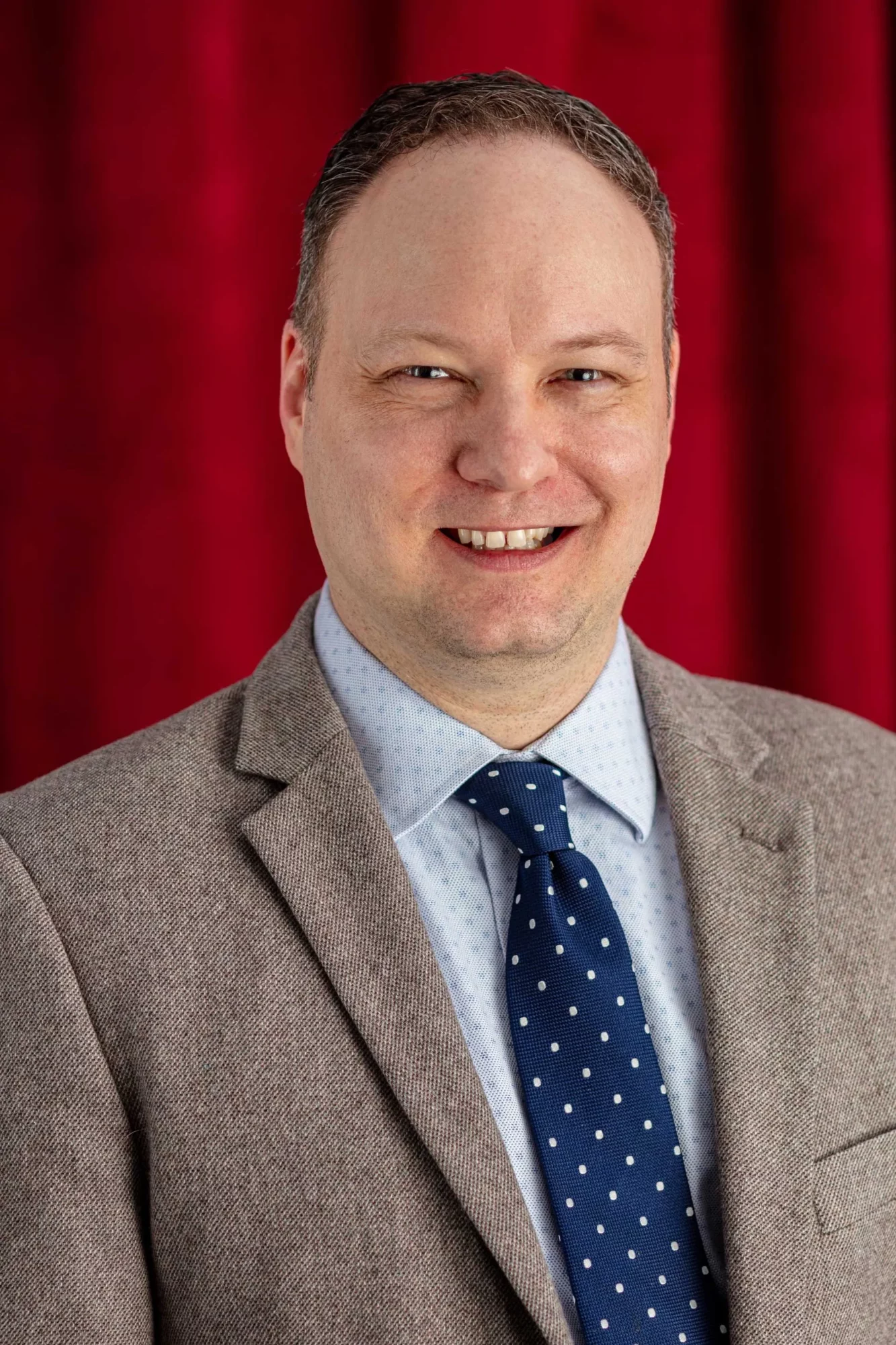
Today we’d like to introduce you to Jim DeGood.
Hi Jim, can you start by introducing yourself? We’d love to learn more about how you got to where you are today?
I grew up in a small rural town in southeast Kansas where arts and culture were hard to come by. I developed late physically, which meant sports were never my entry point. Instead I found my way into the school band, theater, speech and debate. Occasionally a touring performer or historian would visit the high school, and those brief presentations planted something in me: the idea that art connects people to stories larger than the lives they are currently living.
My grandfather Harold DeGood was the lead engineer for KSHB television in Kansas City, and I thought I would follow him into broadcasting. I majored in communication studies at the University of Missouri-Kansas City, and when I needed an internship credit, I mentioned it offhand to an advertising contact at the Kansas City Symphony. She invited me to be her publicity assistant. That was the first time I understood that professional musicians have an entire administrative world supporting them, and my first real encounter with nonprofit work. Something clicked. It made sense in a way very little had before.
From that point I gave my career entirely to arts and culture. I started as marketing coordinator at the Kansas City Symphony, moved through various roles there and across other Kansas City cultural nonprofits, and eventually landed at TRG Arts, an international consulting firm. At TRG I worked with organizations across the size spectrum, from the Pensacola Opera to the Toronto International Film Festival and Lincoln Center. I led the consulting team and helped evolve the firm’s practice.
Then the pandemic hit. Mandatory lockdowns made it nearly impossible for performing arts organizations to gather artists and audiences, and the entire field contracted. Organizations needed to preserve cash and protect staff, not pay consultants. I survived several rounds of layoffs at TRG, but not the final one, in August 2024.
I thought I would leave the nonprofit world for something more stable. I searched for six months. My wife eventually reminded me that helping arts and culture organizations was what animated me, and that I had the knowledge and relationships to do it on my own terms. I am not sure I would have gotten there without her. I launched Cultural Catalysts in January 2025, and since then I have had the privilege of working with organizations including the Cincinnati Opera, City Theatre in Pittsburgh, Music Theatre Wichita, Portland Center Stage, and others. Some things you plan. Some things find you.
We all face challenges, but looking back would you describe it as a relatively smooth road?
Smoother than I expected, honestly, though not without its lessons.
There is a lot to learn about running a business that has nothing to do with your actual expertise. I had managed finances, built marketing pipelines, and developed client relationships across my career. What I had never done was carry all of it at once, alone, without a team to catch what I dropped. In an organization, if your efforts fall short in one area, a colleague can help cover the gap. As a sole practitioner, the pressure is direct and fully felt. This succeeds or fails because of my efforts and mine alone. I have been fortunate to have mentors who have been through it. Keri Mesropov, a former TRG colleague who founded her own firm, Spring Talent, has been a generous guide on the consulting life. Ellen McDonald, who has run her own publicist and consulting practice for several decades and served most of the major Kansas City arts organizations, has been another. You learn differently from someone who built something themselves.
Two challenges have stood out, and they are more connected than they first appeared. The first is visibility. I am someone who has always let his work speak for itself, and I will admit that humility got in my way early on. My brand and marketing consultant, Nicolette Martin of Rooted Brand House, pushed me to articulate what I do, why I do it, and what it is worth — not just to clients but to the field. That process has been genuinely clarifying, even when it has been uncomfortable. Publishing my first piece of thought leadership came with real anxiety.
The second is the rhythm of solo practice: the inevitable ebbs and flows of work and revenue that no one really prepares you for. Mike Michalowicz’s book Profit First helped me structure my finances in a way that makes those swings more navigable. The logistics are manageable. The psychology is harder. When I was at TRG, a high volume of work felt like proof of success. As a sole practitioner, I have had to untangle my sense of worth from my billing hours. That is ongoing work. I am setting different limits now, not because the work is less important, but because the people I come home to are more so.
Thanks – so what else should our readers know about Cultural Catalysts?
Cultural Catalysts is an arts consulting practice built on a single animating belief: when organizations put their audiences first, the revenue follows. That sounds simple. In practice, it requires rethinking how an organization operates at every level, not just how it markets.
The core of my work is something I call the Audience First philosophy. Most arts organizations approach their audiences with a version of the same question: what do we want to say? The Audience First philosophy asks a different one: what do our audiences need to feel? Those two questions produce very different organizations. Audience First is not a marketing framework. It is an enterprise-wide orientation that shapes programming decisions, development strategy, pricing, staffing, and planning. When an institution genuinely centers people, it stops competing for attention and starts becoming essential.
In practical terms, I work with nonprofit performing arts organizations on earned revenue, contributed revenue, and strategic planning. On the earned revenue side, that means building campaign systems around how audiences actually behave, what brings them in, what keeps them coming back, and what they need to feel in order to deepen their relationship with an organization. On the contributed revenue side, I help organizations move beyond transactional fundraising toward relational giving, extending to every donor the kind of cultivation that most organizations reserve only for their largest. On the strategic planning side, I help leaders clarify where they are, envision where they want to go, and pressure-test that vision against audience reality before locking it into a plan.
What sets the work apart, I think, is that I distinguish between affinity and loyalty. Loyalty describes what an organization needs from an audience. Affinity describes what an audience feels toward an organization. Most revenue development systems optimize for loyalty. I build for affinity, because affinity is what produces sustainable financial commitment. An audience member who feels genuinely connected to an institution does not need to be convinced to renew, upgrade, or give. They are already there.
What I am proudest of is something that took years of practice, and honestly a fair amount of cajoling from Nicolette, to finally articulate. Over the course of my career I have absorbed a lot: the inner workings of arts organizations at nearly every level, business practices from for-profit and adjacent nonprofit fields, and a deep understanding of what makes audiences commit to the institutions they love. Cultural Catalysts is where all of that converged into something distinctive. The work I do does not ask clients to subscribe to ongoing software, or to remain in a relationship with me indefinitely in order to see results. I design engagements to build capacity into the organization itself, so that clients understand not only what I recommend and why, but how to apply it and how to sustain it after our work together concludes. The goal is that when I leave, something is different, and it stays different.
If we knew you growing up, how would we have described you?
I grew up in a modest household in rural southeast Kansas with a younger brother and a single working mother. Early responsibility was just the water we swam in. I do not think I would have named it at the time, but looking back I can see that it shaped something in me: a deep investment in justice, independence, and human expression. Those three things were my compass, and most of the adolescent boundary-testing I did can be traced back to one of them.
I was not a sports kid. In a small rural town, that makes you an outsider, and being drawn to language and the arts cemented it. It was hard at the time, in the way that feeling like you do not quite fit is always hard. But it taught me things I still rely on. It taught me how to read people. It gave me genuine comfort with perspectives different from my own. And it built a resilience that has served me well as a consultant, when a prospective client decides not to work with me, I do not have to start from zero to recover from it.
I competed in forensics and debate throughout high school, which turned out to be a reasonable outlet for someone who had opinions and was not shy about sharing them. Our team won the state championship in debate one year and finished runner-up the next, which I remain quietly proud of. I was also voted most talented male in my senior class, though I should say the bar for that distinction in a small Kansas town was not exactly EGOT-level.
What I can see now, that I could not see then, is that all of it pointed in the same direction. The performing arts, the competitive speaking, the early sense of fairness and self-reliance — they were all versions of the same impulse: to understand how people connect to each other, and to find a role in making that happen. I just did not know yet that it would become a career.
Contact Info:
- Website: https://www.cultural-catalysts.com
- LinkedIn: https://www.linkedin.com/in/jim-degood/