





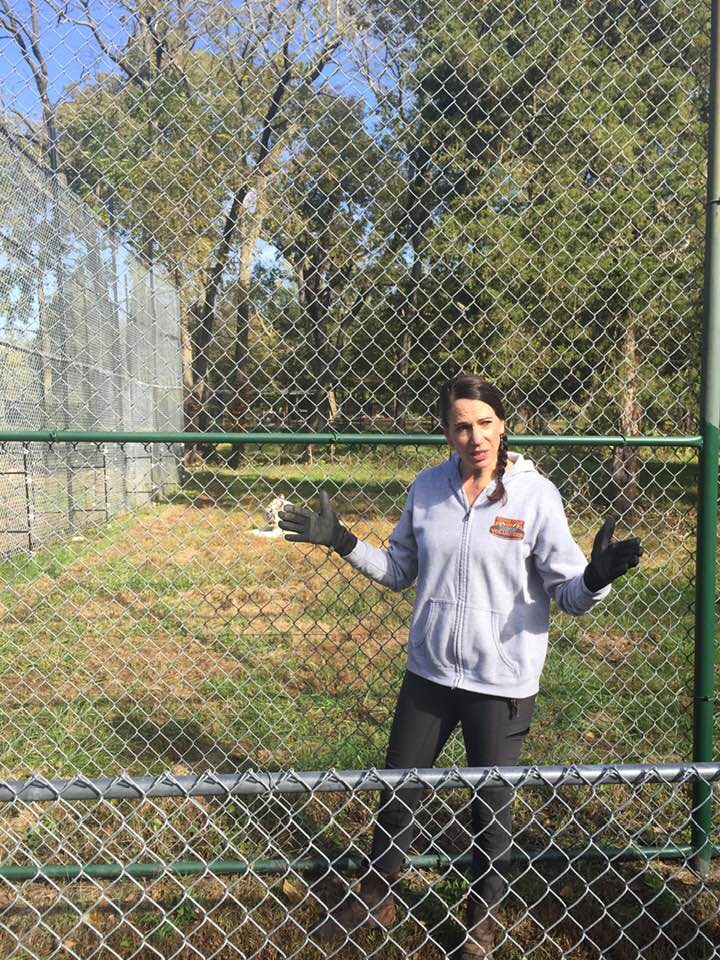
Today we’d like to introduce you to Bettie Auch.
Hi Bettie, we’d love for you to start by introducing yourself.
I first walked into Cedar Cove in August of 2001, before it had really become what people now recognize it as. It was still taking shape—something being built day by day with a lot of hard work and a clear sense of purpose. I came back the following spring and started volunteering Memorial Day weekend in 2002, becoming one of the first volunteers outside of friends and family.
I was trained directly by William Pottorff and Shelly Tooley as an animal care specialist. Billy, especially, had a way of teaching that went beyond the basics. He didn’t just show you what to do—he taught you how to think. How to read behavior, how to respect boundaries with predators, how to move with intention, and how to understand what it really takes to run a sanctuary day to day. A lot of what I know—about the animals, about safety, and about the bigger picture of what Cedar Cove is—comes directly from that time learning alongside him.
For years, I stayed focused on hands-on work. Feeding, cleaning, observing behavior, assisting with veterinary care—doing whatever needed to be done. Over time, I began training other volunteers and became someone people relied on in animal care. From there, my role expanded into operations, helping coordinate the daily flow of the sanctuary, and eventually into financial and administrative responsibilities. There wasn’t a clear line where that shift happened—it just grew out of necessity and being there consistently.
When Billy passed away in 2012, things changed. There wasn’t really a moment to pause—it required stepping up immediately. My role didn’t change in title, but the level of responsibility did. I moved more fully into leadership and decision-making, while also focusing on maintaining the standards and approach he had established. A big part of that time was making sure the foundation he built stayed intact, even as Cedar Cove continued to grow and face new challenges.
Over the years, I worked closely with Steve Klein, and together we carried Cedar Cove forward. We had different strengths, but they complemented each other. Steve handled a lot of the hands-on animal care and facility work, while I balanced animal care alongside operations, financials, volunteer leadership, and organizational direction. We worked side by side, constantly adjusting, solving problems, and stepping in wherever needed. It wasn’t rigid—it was whatever the sanctuary required that day.
Through that partnership, we navigated everything—growth, operational challenges, staffing gaps, and the day-to-day unpredictability that comes with caring for large predators. Cedar Cove doesn’t run on fixed roles; it runs on people being willing to do what needs to be done, and that’s how we operated together.
When Steve passed in February 2026, it was another major shift. Since then, I’ve taken on more of the areas he managed, along with increased leadership and decision-making responsibility. At the same time, there’s been a strong focus on keeping things stable—making sure the animals are cared for, the operations continue, and the organization stays grounded during the transition. It’s been both a practical and emotional adjustment, but the priority remains the same as it always has been.
Outside of Cedar Cove, I’ve been involved in conservation efforts that have shaped how I see this work in a broader context. I’ve worked with organizations like Belize Wildcats and the Fishing Cat Conservancy, and have had the opportunity to participate in mountain lion research connected to David Neils. Through that work, I’ve been involved in field tracking, camera trapping, habitat observation, and supporting research efforts.
Those experiences reinforced something important—what people see in a sanctuary is only part of the story. Understanding how predators function in the wild, how they shape ecosystems, and the challenges they face adds depth to the work we do at Cedar Cove. It’s influenced how I approach education and how I talk to people about these animals—connecting what they see here to the larger role these species play in the world.
What has kept me here for 24 years isn’t just one thing. It’s the animals, the mission, the people who built it, and a strong sense of responsibility to carry it forward. Cedar Cove isn’t something I stepped into—it’s something I grew up in. And over time, it’s become a part of who I am, just as much as I’ve become a part of it.
I’m sure it wasn’t obstacle-free, but would you say the journey has been fairly smooth so far?
Over my 24 years at Cedar Cove, I’ve been directly involved in managing the realities of operating a large predator sanctuary.
I’ve worked hands-on with critically ill animals, supported end-of-life care and medical decisions, and managed long-term health and behavioral challenges. In those situations, I’ve coordinated with veterinarians, participated in critical decisions, and helped keep operations moving under pressure.
I’ve also been involved in animal transport and intake, working through long-distance logistics, permits, coordination with other facilities, and ensuring safe transitions for the animals. These situations are often unpredictable, so a lot of it comes down to problem-solving in real time.
Operationally, I’ve helped navigate staffing shortages, financial constraints, facility limitations, growth challenges, and crisis situations. That’s meant stepping into multiple roles and adapting quickly as needs change.
Overall, the work has required physical endurance, emotional resilience, quick decision-making, and the ability to lead through uncertainty—while staying focused on the animals and the mission.
Appreciate you sharing that. What else should we know about what you do?
’ve spent about 25 years working in accounting and finance, mostly in leadership roles where I’ve had the chance to get really involved in both the numbers and the systems behind them. A lot of my focus has been on ERP systems and making sure everything—from processes to reporting—actually works the way the business needs it to.
I tend to gravitate toward the messy, complex problems—especially when systems, data, and accounting all intersect. I’m pretty hands-on, and I like digging in to figure out what’s working, what’s not, and how to make it better. Lately, I’ve also been really interested in how AI and automation can help make accounting more efficient and accurate, without losing control or visibility.
I think what sets me apart is that I try to keep things practical. I’m not just focused on designing something that looks good on paper—I want it to actually work for the people using it every day. I also care a lot about the team side of things—helping people grow, setting clear expectations, and building something that lasts beyond just one person.
What I’m most proud of is probably the consistency over time—helping teams get stronger, improving processes, and leaving things in a better place than I found them. And outside of work, I’ve spent over 20 years volunteering in wildcat conservation and education, which has been a really meaningful way to stay connected to something bigger than my day-to-day job.
Any advice for finding a mentor or networking in general?
Build connections throughout your life, both personally and with your career. Never burn bridges, you never know where that person will show up again in your future.
Contact Info:
- Website: https://www.cedarcoveconservationcenter.org
- Facebook: https://www.facebook.com/CedarCoveConservation