



Today we’d like to introduce you to Amy “Yarn Rambo” Stevens.
Hi Amy “Yarn Rambo”, so excited to have you on the platform. So before we get into questions about your work-life, maybe you can bring our readers up to speed on your story and how you got to where you are today?
I’ve been creating for as long as I can remember. Not quiet-still-life-making. I mean glue-on-my-hands, cardboard-engineering, string it together, “we can build it” making.
Most of my favorite memories are tactile and loud in the best way. Craft nights with my Mom where the table disappeared under fabric, glue, ribbon, and possibility. Sitting on my maternal Grandmother’s lap while she sewed, watching that needle fly up and down like it was keeping time for the whole house. With my Dad, we built big. Measured twice, built once, sometimes rebuilt because why not make it better.
Creativity wasn’t a hobby in our house. It was family time. It was how we connected.
My brother was the “artist.” I was the “crafter.” He had the sketchbook glow, I had the glorious chaos pile. Cardboard. Tape. Buttons. Whatever we could find. And honestly? I loved it.
Somewhere along the way I absorbed the idea that being an artist meant you had to draw flawlessly or paint traditionally. It took me well into my 30s to realize how wrong that was.
Then I found tufting, or maybe tufting found me.
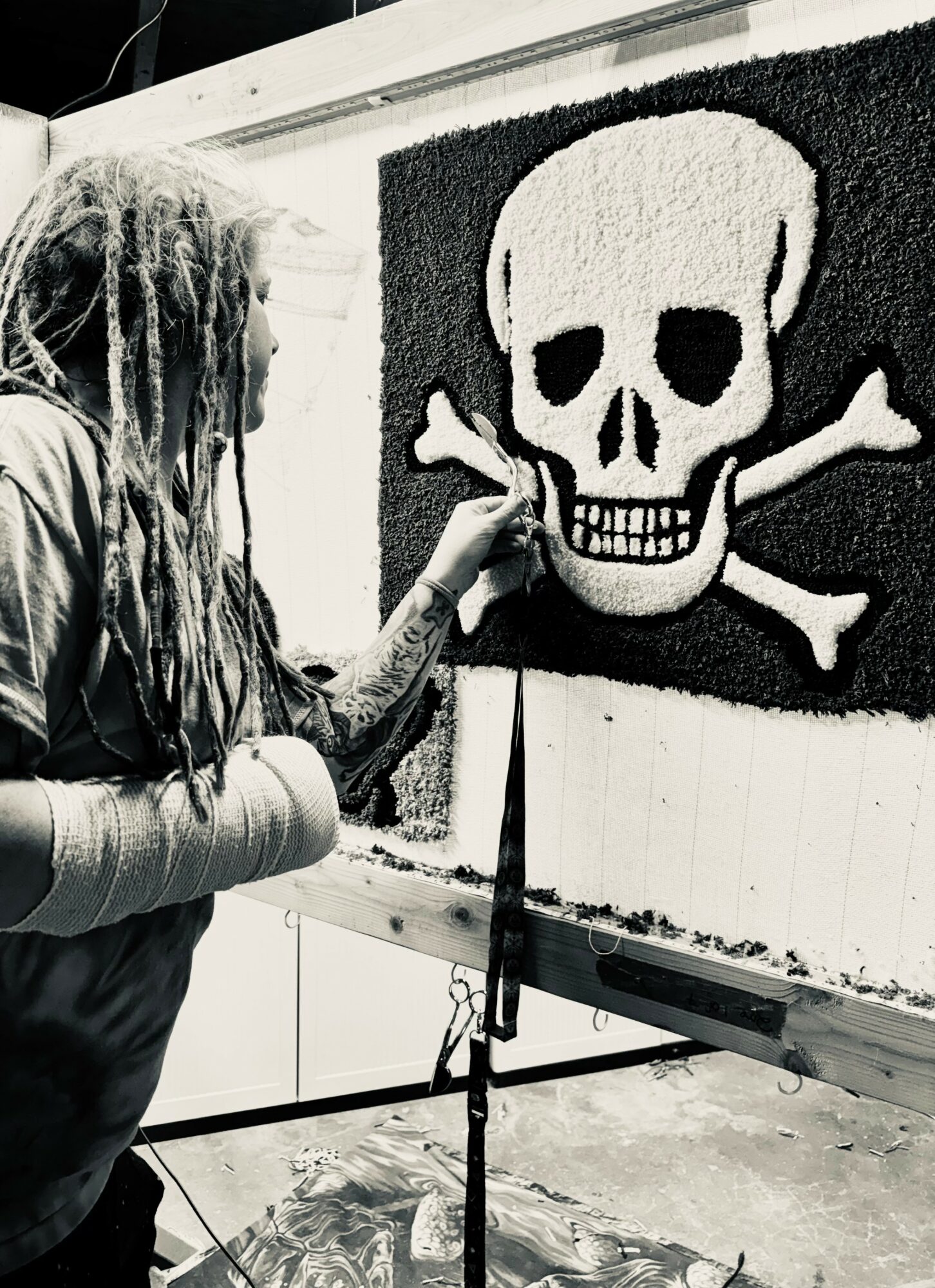
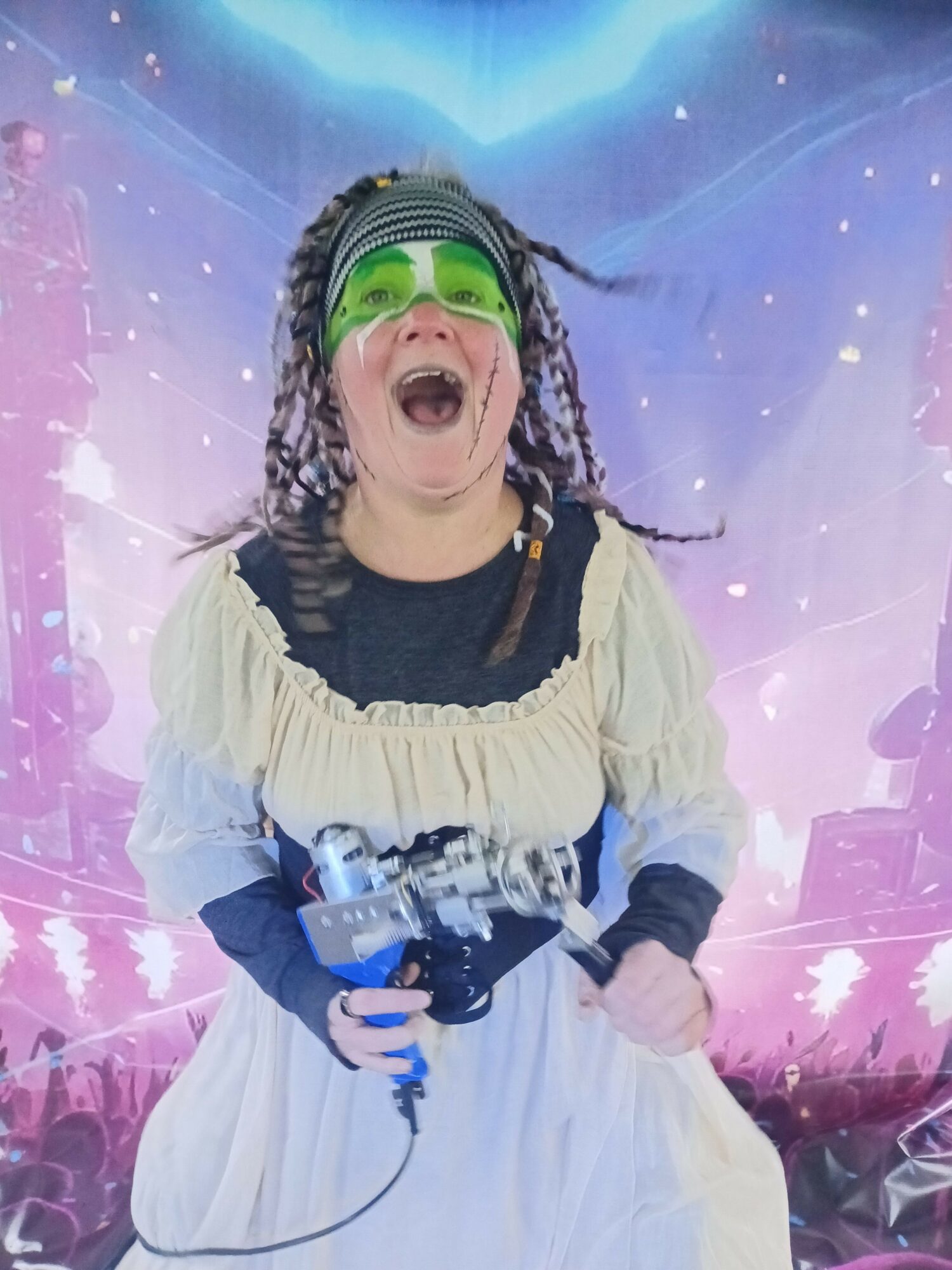
The first time I picked up a tufting gun, it felt like plugging into a whole new dimension. Yarn became colorful, touchable, fuzzy “paint”. The hum rolled like a combination sewing and tattoo gun. There was Motown soul in the rhythm, but deeper than that, it felt spiritual, like alignment of roots and purpose.
When I started tufting, there were maybe 30ish people tufting. No array of supply shops, or Amazon ordering, no starter kits, no YouTube tutorials. We were sourcing creatively, and learning in real time. There was no roadmap. We were building the medium, secondary or supplementary tools, and art-form in real-time.
With tufting, due in part that there were no instructions, suddenly everything artfully made sense. Tufting gave me permission to, well stop waiting for permission to be an Artist.
My dear (now deceased) Sister from another Mister, coined me “Yarn Rambo”, which quickly fit not as a nickname, but as a declaration of who I’ve been my entire life.
I’m sure it wasn’t obstacle-free, but would you say the journey has been fairly smooth so far?
Most of my obstacles have really just been opportunities in disguise.
I found tufting in October 2019 and got my first gun in January 2020. Timing was wild. I was learning a brand-new, barely-documented art form right before the world shifted. There were almost no learning resources. Supplies weren’t readily available. Quality materials were even harder to track down. It was scrappy ingenuity from day one.
Add in poor hand health, there have been moments where I’ve had to slow down, adjust my grip, rethink my setup, and honor a different pace. I literally had to “finger it out.” But even that felt less like a wall and more like a recalibration. I kept tufting. Just differently.
If I’m being honest about what might “hold me back,” it’s probably that I’m wired to bring everyone with me. I want collaborators in the spotlight. I want shared wins. I want my people rising alongside me. The real world doesn’t always reward that kind of collective energy. It tends to spotlight individuals, not communities.
But I don’t think I’ll ever stop trying to lift others as I climb. If that stretches the timeline on fame or recognition, I’m okay with it.
Another very real challenge? Finances. Art supplies are expensive, especially when you care about quality and supporting other entrepreneur shops instead of defaulting to big box stores and giant online sites. I choose biodegradable, ethically sourced yarn. I choose Primary Tufting Cloth (PTC) over burlap. I choose good tools sold by humans with warranties and maintenance plans. I choose building / creating secondary tools VS buying them. That commitment adds up.
It’s actually one of the reasons I started developing my own tufting supply line. I saw a gap in accessible, high-quality materials, and I needed a sustainable way to support my own practice, offer workshops at affordable prices using quality supplies, and help others step confidently into the medium.
So no, I don’t have a tragic backstory.
I have grit. I have adaptability. I have a stubborn commitment to doing things well and bringing people along.
And I’m still building.
Appreciate you sharing that. What else should we know about what you do?
I’m a fiber artist who specializes in cut-pile tufting, and lately I’ve been layering other art forms back into my practice. Tufting is my anchor, but it’s not the only creative language I speak.
I’m known for pushing limits instead of coloring inside them. My work is vibrant, neon and high-contrast. Sometimes loud enough to feel like it’s humming. I try not to work from reference images or chase trends. I’d rather pull something straight out of my own brain and see what happens — even if it doesn’t get the likes or comments. The spark matters more than the algorithm.
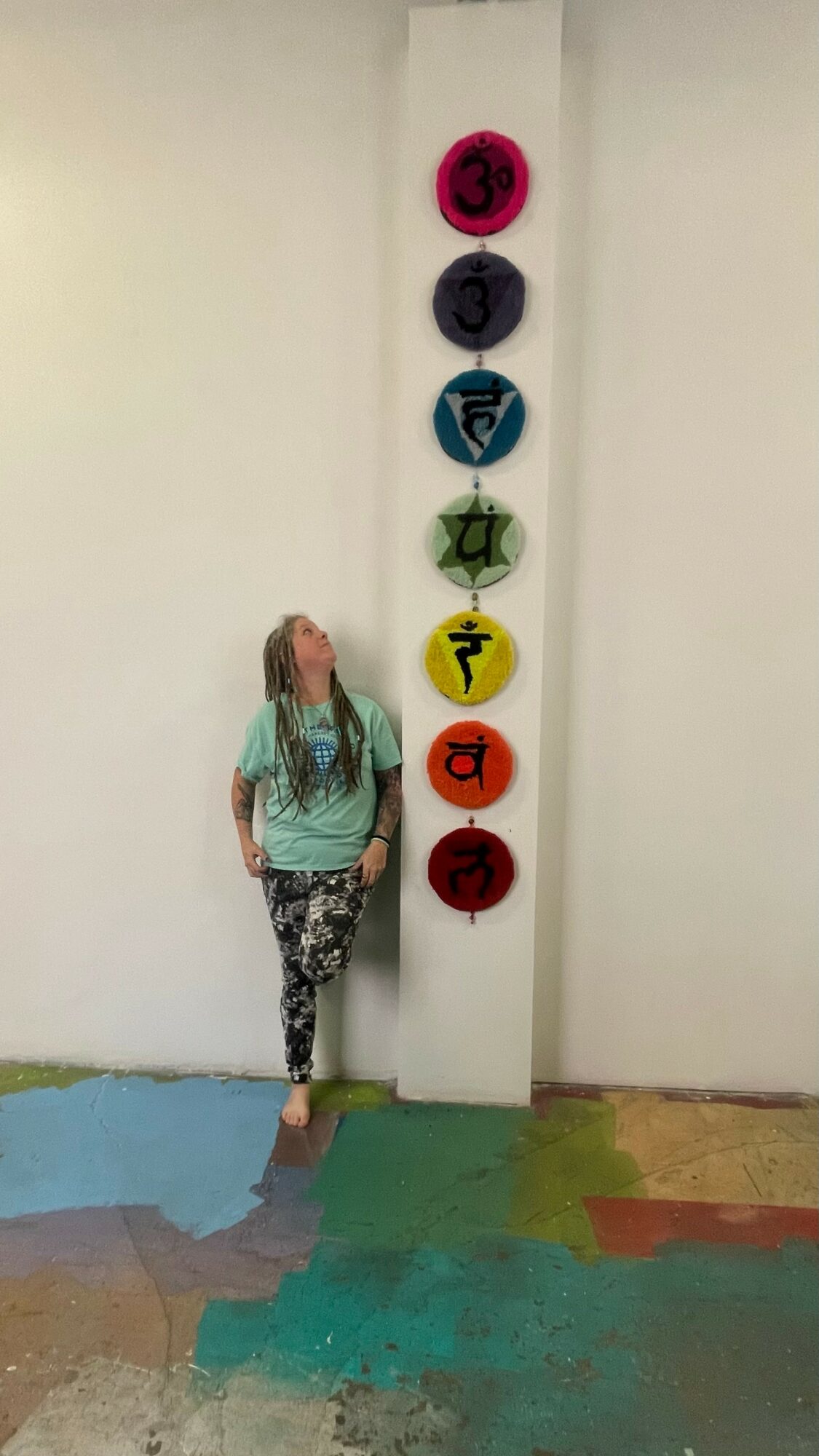
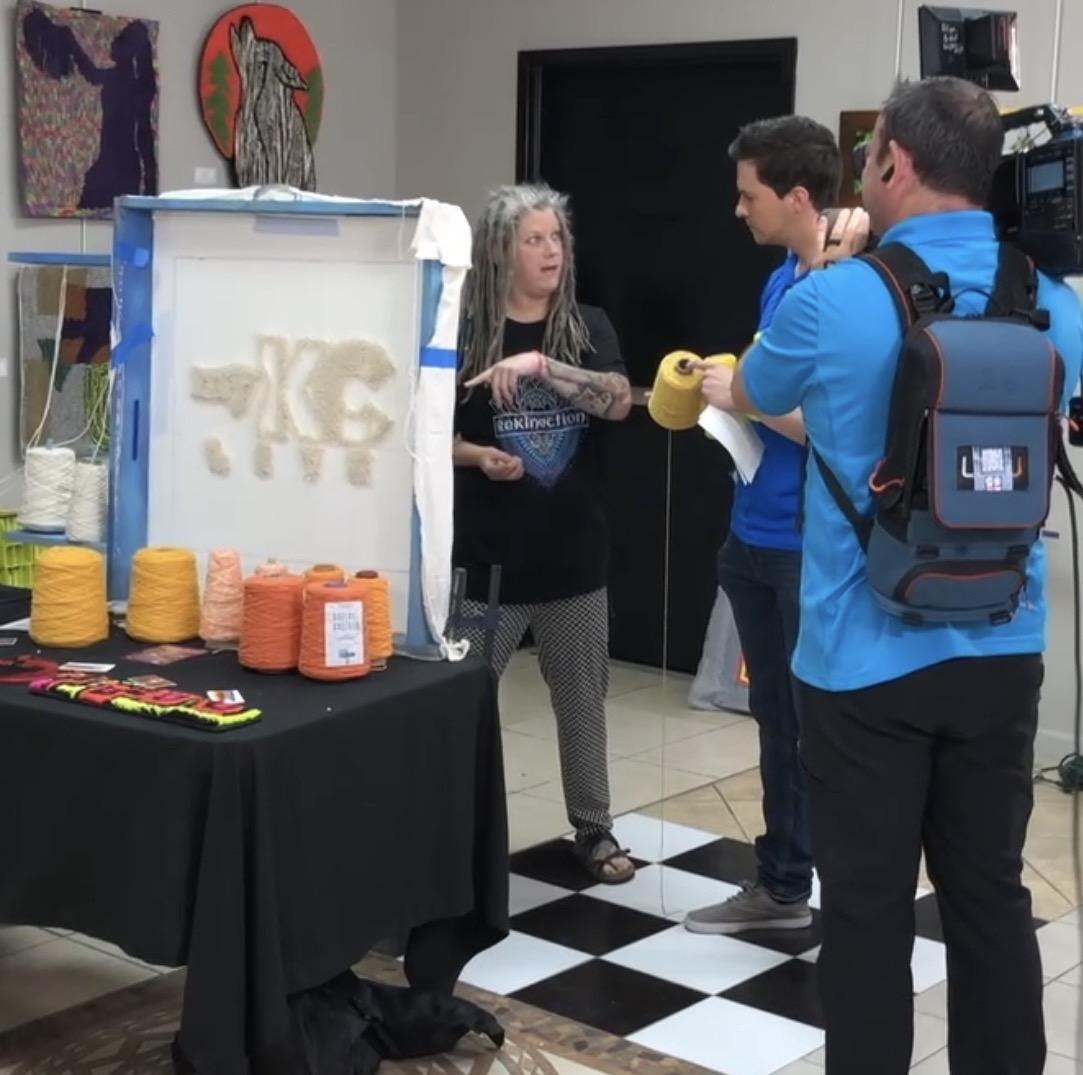
I’ve carried tufted fiber into fine art galleries across Kansas City on both sides of the state line, throughout the Midwest, and even to the East Coast. Sometimes I’ve adjusted my work to fit traditional gallery systems. Other times, galleries have figured out how to hang fiber properly. Either way, tufting walked into rooms it wasn’t originally invited into.
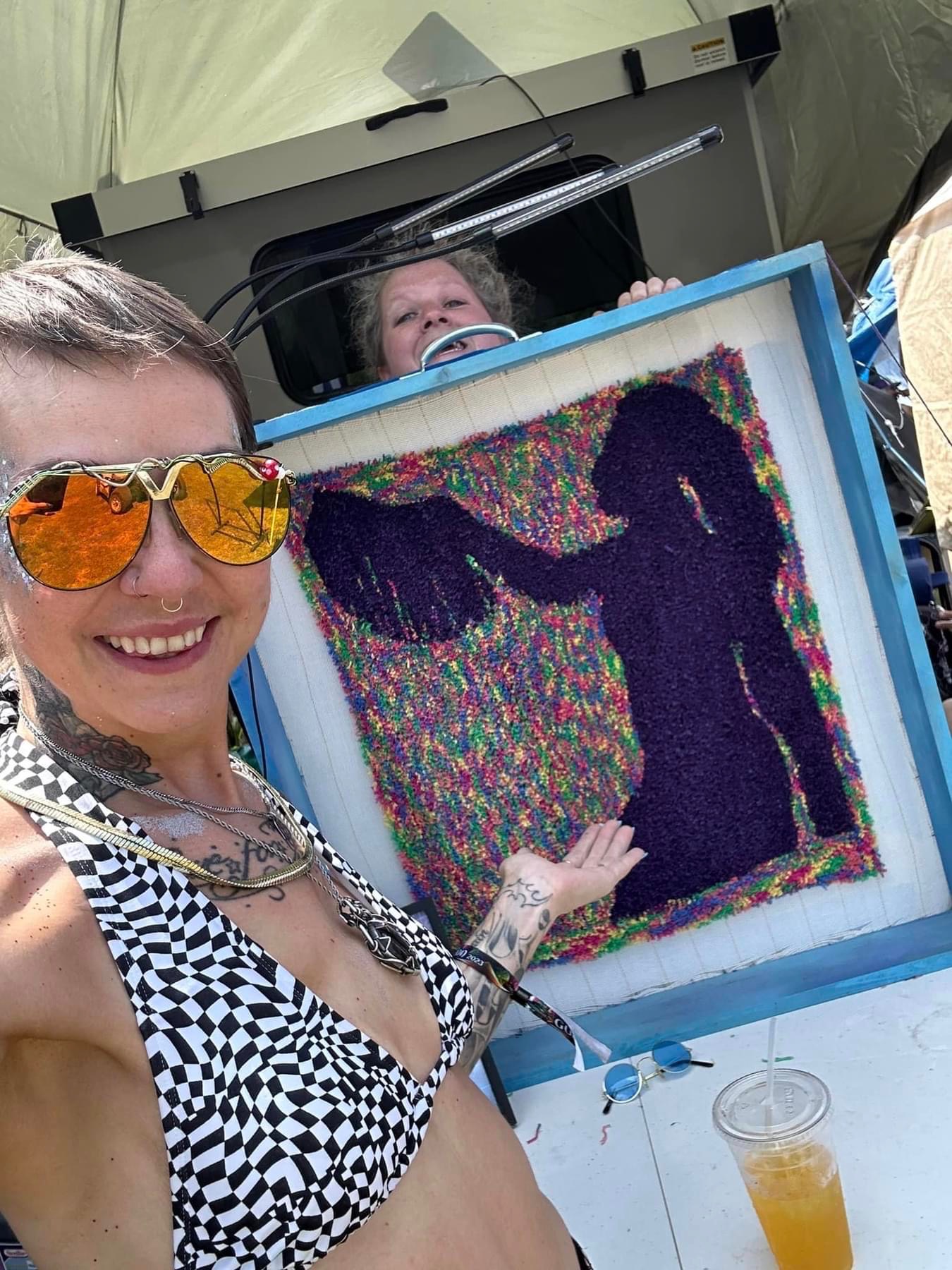
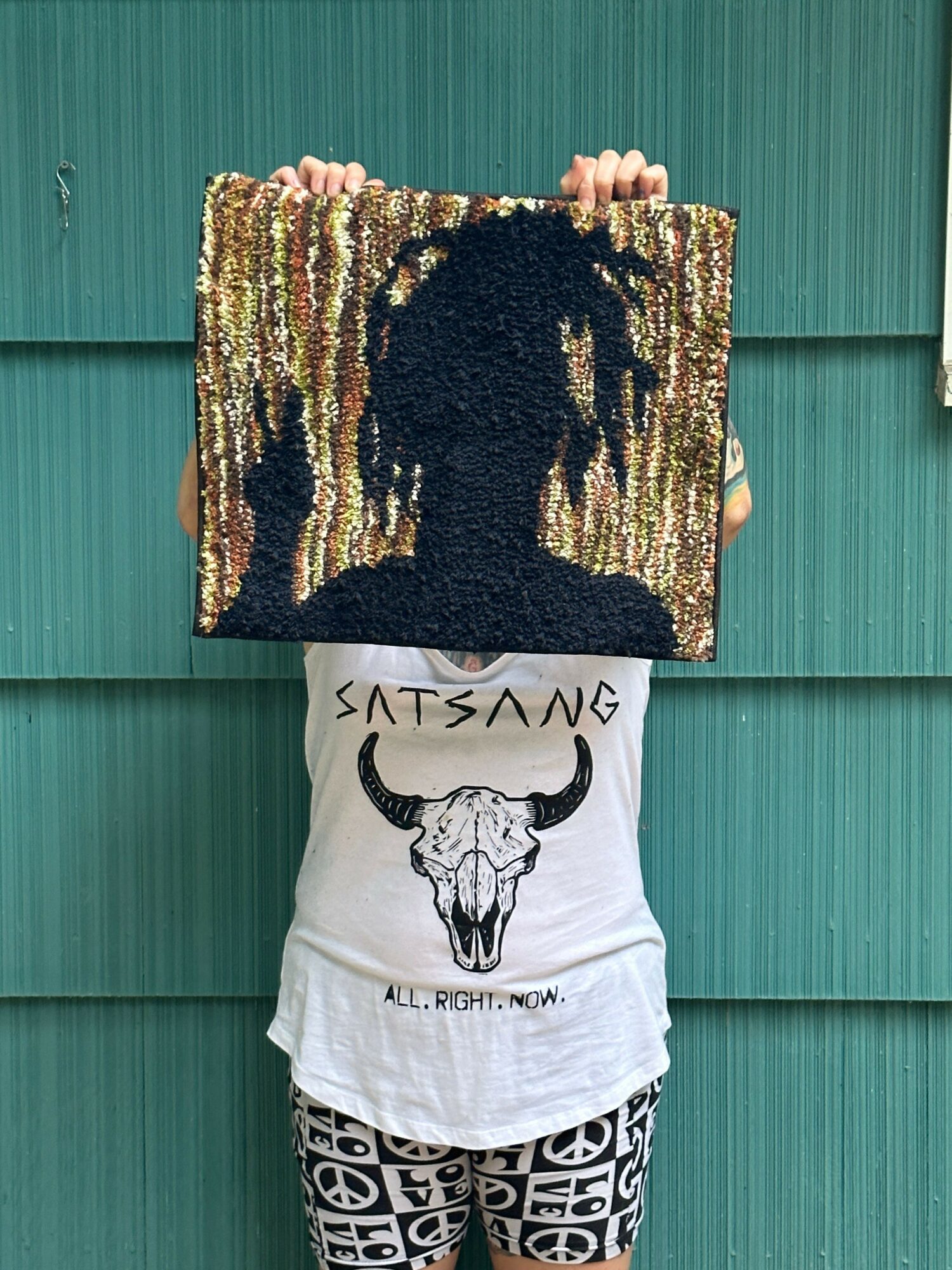
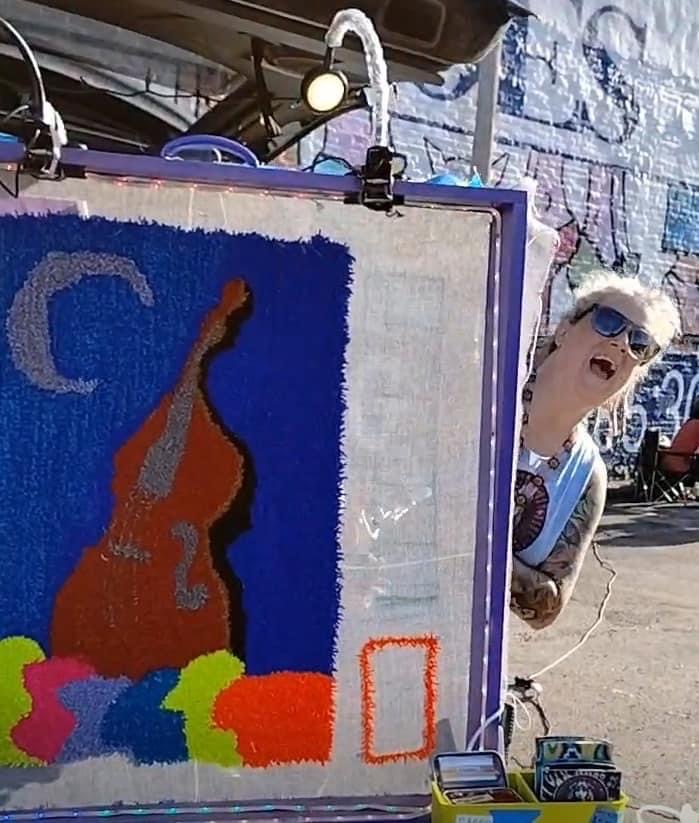
Most of my work leans neon pop-art energy. Even when it’s not strictly neon, it’s bold and saturated. I want it to hum, to vibrate, to feel like soul with a bassline — and to be touched. Fiber isn’t meant to sit politely behind glass. Texture is the interactive experience.
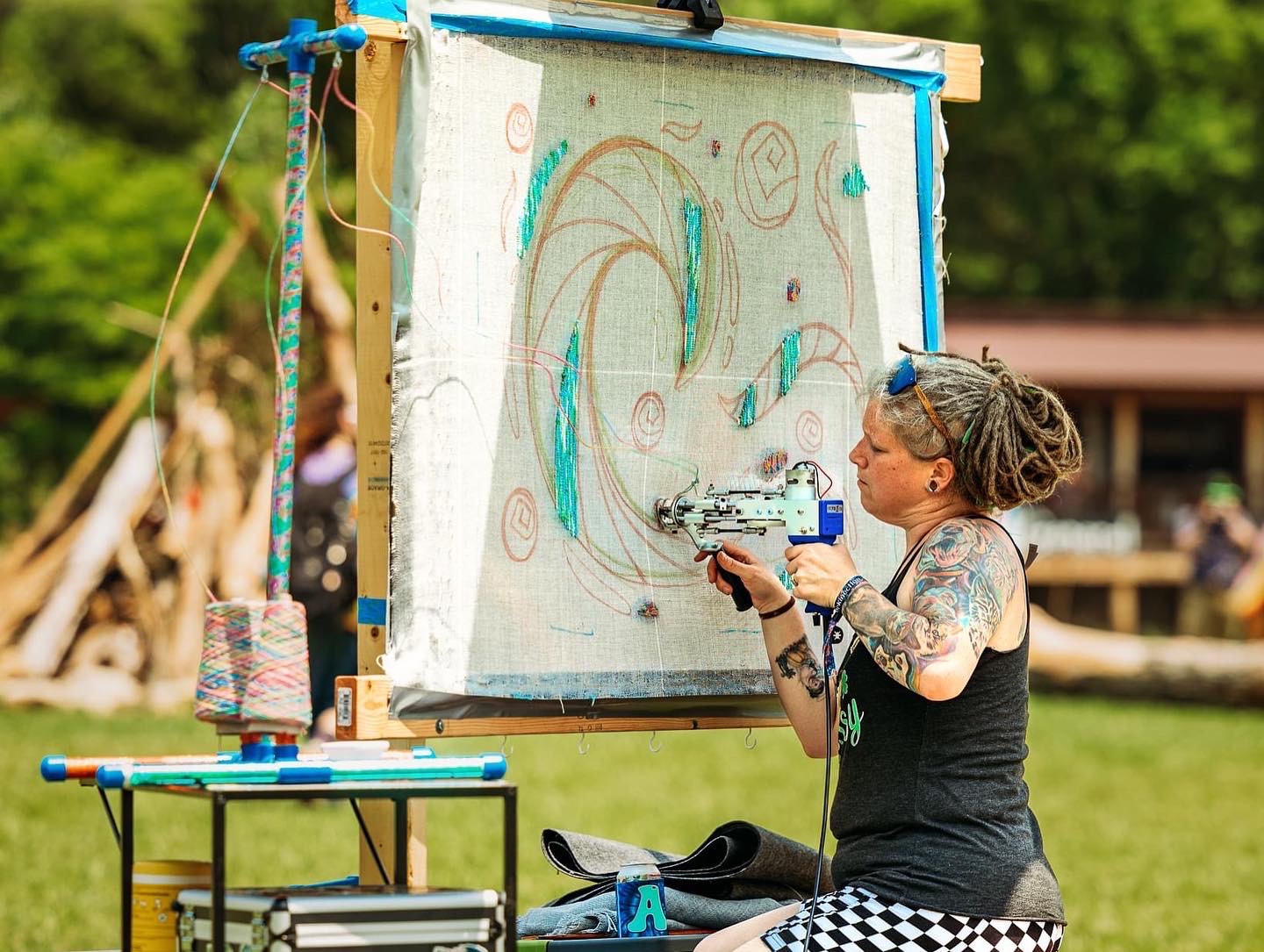
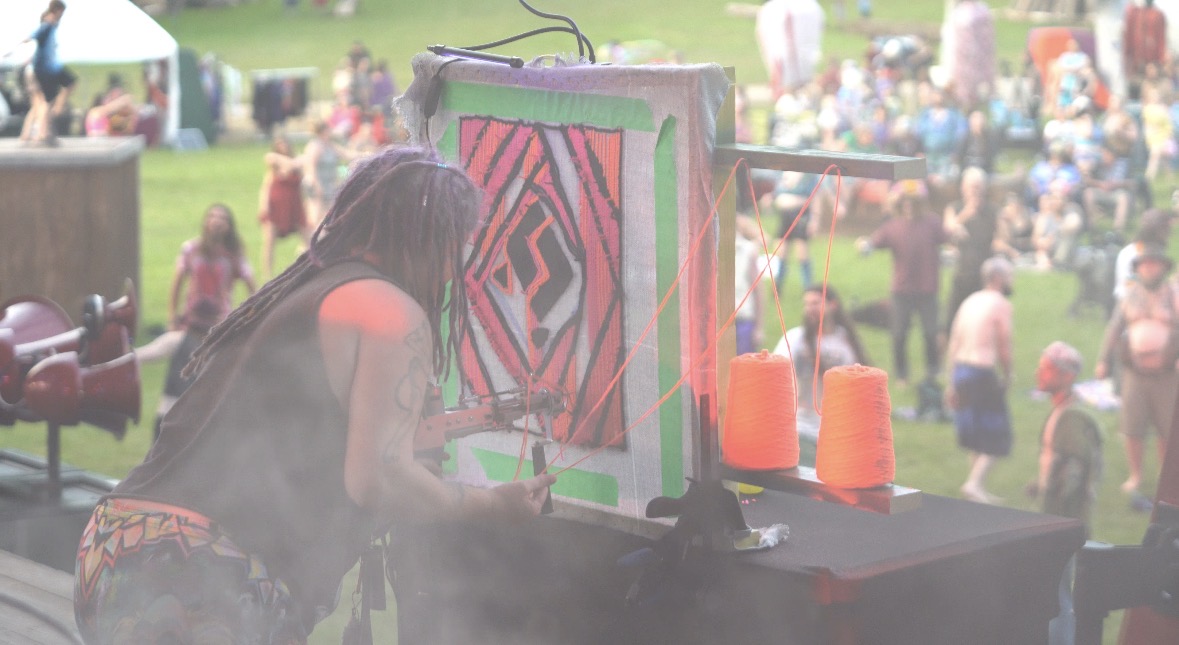
That same energy shows up in how I work. I tuft on the go at festivals, wedding receptions, fundraisers, and onstage at music festivals. The second the machine starts humming, curiosity builds. People gather. They lean in. They watch a design appear in real time.
And here’s the thing: tufting on the go or in the real world, during or part of a performance, doesn’t allow for a perfectly carved, obsessively refined piece. It’s “tuft it and leave it” energy. Being able to step back after 60 minutes, while people were watching, and say, “Yeah. I made that,” without picking apart every imperfection — that’s a special kind of talent. It’s trust. It’s confidence. It’s letting the piece compliment the moment which is something not meant for perfection.
Even though I use biodegradable, sustainable yarn, I still bring a vacuum when I tuft outside. Watching me vacuum the grass usually earns a laugh… or at least a long stare.
What am I most proud of?
Failing, loudly, yelling a few obscenities, learning from the experience, trying again. And again. And again. Resilience is the backbone of my practice.
Highlights? Tufting onstage with ReCycled Funk during ReKinection in front of thousands of people, my very first commission, and realizing I can actually draw. For most of my life I said I couldn’t draw more than a stick figure. Drafting tufting designs unlocked digital art I’m genuinely proud of.
I’m also proud of never fitting neatly into a box. Don’t label me, I’ll break it. I move between craft, fine art, performance, and mentor without asking permission.
Obtaining a studio at Bunker Center for the Arts in east crossroads, where not only I have a space away from home to create art, but a public space to offer workshops for others to find their creative side.
What sets me apart?
I exclusively use biodegradable, sustainable, earth-friendly yarn instead of acrylic. I choose Primary Tufting Cloth over burlap. I invest in quality tools from small businesses. I care about what I’m putting into the world and who I’m supporting when I do it.
And beyond materials, I care about helping other people find their creative spark. I’m just as comfortable behind the frame as I am in front of it. I believe in sharing the spotlight. I believe fiber belongs anywhere and everywhere art belongs.
For me, it’s not just about making something pretty.
It’s about making something powerful — and letting people feel and be a part of it.
What do you like and dislike about the city?
I love that Kansas City lives in that in-between space — KCK and KCMO, two sides of a state line with different textures but the same heartbeat. You cross a bridge and the vibe shifts a little, but the soul stays steady.
What I love most is that it’s a big city with a small-town feel. I was born and raised in a town with under 10,000 people, so I know what that tight-knit energy feels like. KC carries some of that; people smile, they’ll hold a door, let you zipper merge, help a neighbor. There’s still kindness here, and that matters to me.
It’s country living with city adventures. I can be in the center of arts, culture, diversity, Friday night life, and weekend magic in about 20 minutes. And I can flip that same 20 minutes and be creek walking, off-roading, at a dog park safe for my Pitties, star gazing with cicadas and frogs as the only noise. That balance feels rare.
I also love that the city isn’t just a concrete grid. It’s built into hills, trees, water, skyline views layered into nature. It has texture. And the art scene is growing. I wish it was growing as loudly as the sports scene, but growth is growth. I see more artists carving space, experimenting, taking risks. That excites me.
Spooky season here? Elite. The haunted scene is one of my favorite things about this city. The whole area lights up and haunts wildly! That kind of full-commitment energy is fun to take part of.
And for better or worse, KC is passionate. People show up hard for what they believe in. Even if it’s not my thing, I respect the intensity — especially when it stays respectful.
Now, what do I dislike?
The weather drama. We can get all four seasons in one day. The gray winters and below-freezing temps aren’t exactly my vibe. It’s still better than where I grew up south of Chicago, but I won’t pretend I love it. I have enjoyed this winter as its been bright and warmer than normal.
I also wish the live music scene had stronger audience support. No matter the size or following of the artist, even when they command real crowds in other cities, they don’t always get the same turnout here. It makes it harder to keep diverse music coming through town. Support matters.
I feel like KC is a solid city for artists following traditional fine art paths — gallery representation, structured programs, institutional routes. But for entrepreneurial artists building hybrid careers — teaching, performing, selling supplies, activating community spaces — the support systems are thinner. Studio space, materials, and funding add up fast, and there aren’t as many clear pathways for artist-entrepreneurs to grow sustainably.
Still, I’m here because I believe in what this city is and can be.
KC has grit. It has heart. It has potential that’s still unfolding. And I’m excited to be part of that story.
Contact Info:
- Website: https://www.yarnrambo.com
- Instagram: https://www.instagram.com/yarnrambo
- Facebook: https://www.facebook.com/yarnrambo
- Other: https://linktr.ee/YarnRambo